Aptitude Assessment: Design & Structural Analysis
APTITUDE ASSESSMENT
Section 3: Design Standards, Structure & History
General Instructions: For each question, carefully read the prompt. For Part A, choose the best answer from the given options and indicate your selection clearly. For Part B, explain your reasoning in your own words, adhering strictly to the specified word limit.
Question 10: Ergonomics & Design Standards
Part A (Multiple Choice):
The diagram below illustrates the relationship between a person of average height and a standard kitchen counter.

What is the generally accepted standard height for a kitchen counter to ensure ergonomic comfort for the average user?
Part B (Short Answer & Justification):
In your own words, explain the fundamental ergonomic principle behind establishing a standard height for a work surface like a kitchen counter. Why is this specific height range considered optimal? Write NO MORE THAN 70 WORDS.
Question 11: Structural System Analysis
Part A (Multiple Choice):
The building shown below is the Indian Institute of Management (IIM) Ahmedabad, designed by Louis Kahn. It is renowned for its monumental brickwork.

What is the primary structural system used in this building?
Part B (Explanation based on Visual Evidence):
Based on the visual evidence in the photograph, explain why you chose that structural system. What visual cues in the building's design indicate how it is holding itself up? Write NO MORE THAN 90 WORDS.
Question 12: Industrial Design & Conceptual Logic
Part A (Multiple Choice):
The iconic piece of furniture shown below was designed by Eero Saarinen in 1956.
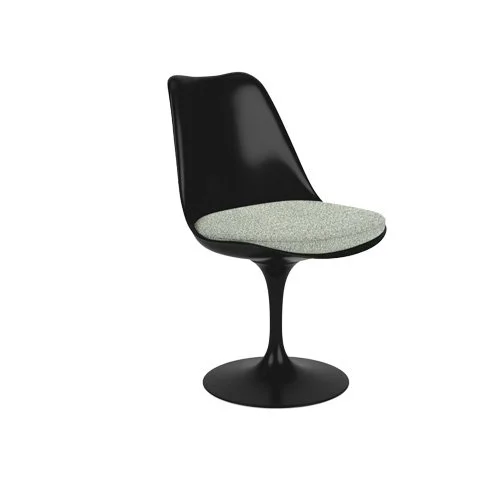
What is the common name for this chair?
Part B (Conceptual Explanation):
Beyond its distinctive aesthetic, the chair's design was a direct solution to a problem the architect had identified. What was the core conceptual goal behind the chair's single-leg pedestal base? Explain in your own words. Write NO MORE THAN 70 WORDS.
INSTRUCTOR'S GUIDE & GRADING RUBRIC [CONFIDENTIAL]
Analysis for Question 10
Model Answer & Solution
Part A: (B) 900 mm (or approximately 36 inches)
Part B: The fundamental principle is to create a work surface that minimizes strain on the user's body during common tasks. The standard height of 900mm is considered optimal because for a person of average height, it falls comfortably around their hip or elbow level. This allows them to perform tasks like chopping vegetables or mixing ingredients with their arms bent at a roughly 90-degree angle, which is a neutral and efficient posture. A counter that is too low would cause the user to hunch over, leading to back and neck strain. A counter that is too high would force the user to raise their arms and shoulders, causing fatigue and strain in the upper body.
Teacher's Notes: Profiling & Analysis
1. Knowledge Points Tested:
- Design Standards (Archetype P/T): Does the student know common, standardized dimensions used in architectural and interior design?
- Ergonomics: Do they understand the principles of designing for the human body to ensure comfort, safety, and efficiency?
- Practical Reasoning: Can they connect an abstract dimension to a physical, real-world function and user experience?
- Vocabulary: Ergonomics, posture, strain, work surface, standard dimension.
2. Core Logic & Thought Process:
- Step 1 (Knowledge Retrieval): The student must access their memory of standard architectural dimensions. This is a piece of factual, practical knowledge.
- Step 2 (Selection): They must choose the correct value. 900mm (36") is the industry standard.
- Step 3 (Principle Analysis): For Part B, the student needs to think "Why?" They must connect the counter's height to the human body.
- Step 4 (Functional Justification): They should explain that the height relates to the user's arm and back position. A strong answer will describe the ideal posture (arms at a 90-degree angle) and the negative consequences of incorrect heights (hunching, shoulder strain).
3. Potential Hurdles & Common Errors (Villain's Playbook):
- The "Guess the Number" Game: The student has no knowledge of standards and simply guesses.
- Confusing with Other Standards: A student might confuse kitchen counter height with a table/desk height (
~750 mm) or a bar counter height (~1050 mm). This is a sophisticated error testing precision. - The "Vague-ifier" Villain: In Part B, gives a generic answer like "It's a comfortable height" without explaining the specific ergonomic reasons related to posture and minimizing physical strain.
- Ignoring the "Why": The student may have memorized the number but never considered the human-centered reasoning behind it.
- Word Limit Adherence: Students may struggle to convey a comprehensive explanation concisely within the 70-word limit, indicating a need for practice in summarization and precise language, which is critical for IELTS Writing Task 1.
Rubric for Profiling Student Logic (Question 10)
| Profile Type | Part A (Choice) | Part B (Justification) | Analysis |
|---|---|---|---|
| The Ergonomist | Correct (B) | Provides a clear explanation linking the 900mm height to the average user's elbow height, neutral posture, and the avoidance of back/shoulder strain, within the word limit. | Excellent. Thinks like a human-centered designer. Understands that design is driven by the data of the human body, not just aesthetics. Demonstrates strong concise writing skills. |
| The Standard-Follower | Correct (B) | Gives a vague or circular justification ("It's the standard height because it's what's normally used") or struggles to articulate the ergonomic principle concisely within the word limit. | Good factual recall of industry standards but lacks the deeper "why" of design reasoning and/or conciseness. Their knowledge is technical but not yet analytical or human-centric, or they struggle with succinct explanation. |
| The Muddled Reasoner | Incorrect (A, C, D) | Chooses a height for a different function (e.g., a desk or bar) and may provide a justification that is logical for that incorrect choice. | The student has some knowledge of standards but misapplies them. They are trying to reason but their data is imprecise. A highly coachable profile, especially on specific architectural terminology and standards. |
| The Guesser | Correct (B) or Incorrect | Cannot provide any logical justification, or the reason is nonsensical, or exceeds the word limit significantly without substance. | Indicates a lack of foundational knowledge in practical design standards and/or poor explanatory skills. The student is not yet thinking about the user in a technical way and needs fundamental language development for justification. |
Analysis for Question 11
Model Answer & Solution
Part A: (A) Load-bearing Masonry
Part B: The visual cues indicating a load-bearing masonry system are the massive, thick brick walls that dominate the facade. The openings for windows and walkways are not simply holes in a curtain wall; they are clearly carved out of the thick wall mass, often through the use of deep arches and concrete lintels that are integrated into the brickwork itself. There is no visible external frame (like steel or concrete columns and beams) that the walls are attached to. Instead, the walls themselves are doing the work of carrying the load of the floors and roof down to the foundation, which is the fundamental principle of load-bearing construction.
Teacher's Notes: Profiling & Analysis
1. Knowledge Points Tested:
- Structural Principles (Archetype T/P): Can the student visually differentiate between a load-bearing wall system and a framed system?
- Architectural History: Can they connect a major 20th-century building to its structural logic?
- Visual Analysis: Can they "read" a building's structure from its facade?
- Vocabulary: Load-bearing, framed structure, masonry, arch, facade, curtain wall.
2. Core Logic & Thought Process:
- Step 1 (Visual Analysis): The student observes the image, noting the sheer mass and thickness of the brick walls.
- Step 2 (System Deduction): They must ask: Are the walls just cladding on a hidden skeleton, or are the walls the skeleton itself? The visual evidence (thick walls, deep-set openings, integrated arches) suggests the walls are doing the work.
- Step 3 (Classification): They match this deduction to "Load-bearing Masonry."
- Step 4 (Justification): They must articulate the visual evidence, contrasting what is visible (thick, solid walls) with what is absent (a separate frame), all while being concise.
3. Potential Hurdles & Common Errors (Villain's Playbook):
- The "Modern Frame" Assumption: Many students assume all large, modern buildings are framed and that masonry is just a decorative skin.
- The "Vague-ifier" Villain: Says "It's made of brick" without explaining how the *use* of brick indicates the *structural system*. They describe the material, not the method.
- Incorrect Terminology: Might choose (D) and incorrectly identify arches as part of a "frame," failing to understand they are elements *within* a load-bearing wall.
- Word Limit Adherence: Explaining structural concepts concisely can be challenging. Exceeding the 90-word limit or sacrificing clarity for brevity indicates a struggle with academic precision and IELTS-relevant writing skills.
Rubric for Profiling Student Logic (Question 11)
| Profile Type | Part A (Choice) | Part B (Justification) | Analysis |
|---|---|---|---|
| The Integrated Thinker | Correct (A) | Correctly identifies the system and explains the choice by pointing to the massive, thick walls and the absence of a separate structural frame, clearly and concisely within the word limit. | Excellent. Can read structural systems from visual evidence and connect them to historical knowledge. Understands the difference between structure and cladding. Demonstrates strong ability to synthesize visual information into a coherent written explanation. |
| The Visual Analyst | Correct (A) | Correctly identifies the system based on visual evidence ("the walls are really thick and seem to be holding everything up") but lacks formal vocabulary or struggles slightly with conciseness within the word limit. | Strong visual reasoning and structural intuition. The core logic is sound, but they need to build the formal language to articulate their insights and practice writing within constraints. |
| The Muddled Reasoner | Incorrect (B, D) | Provides a justification that misinterprets the visual evidence, for instance, by calling the integrated lintels a "concrete frame," or fails to address the prompt fully. | Shows a fundamental misunderstanding of the difference between a load-bearing system and a framed system. Their visual analysis is flawed and their explanation reflects this. Needs targeted instruction on structural typologies and clear descriptive writing. |
| The Guesser | Correct (A) or Incorrect | Cannot provide a logical justification based on the image, or the explanation is irrelevant to structural principles, or largely ignores the word limit. | Lacks the ability to visually deconstruct a building's structure and the academic vocabulary to discuss it. Needs foundational instruction on primary structural typologies and basic analytical writing. |
Analysis for Question 12
Model Answer & Solution
Part A: (C) The Tulip Chair
Part B: The core conceptual goal was to solve what Eero Saarinen called the "ugly, confusing, unrestful world" created by the traditional four legs of chairs and tables. He wanted to "clear up the slum of legs" in the domestic environment. The single pedestal base was a structural solution to create a unified, sculptural piece of furniture where the seat and leg were one, providing visual clarity and cleaning up the visual clutter underneath tables and in rooms.
Teacher's Notes: Profiling & Analysis
1. Knowledge Points Tested:
- Design History: Can the student identify a canonical piece of 20th-century furniture design and its architect?
- Conceptual Thinking: Do they understand the problem-solving intent behind a design, beyond its looks?
- Vocabulary: Pedestal base, visual clutter, organic form, sculptural.
- Holistic Design: Do they recognize that architecture often includes the design of objects?
2. Core Logic & Thought Process:
- Step 1 (Visual Recognition): The student observes the chair's unique form (wine-glass shape, single leg).
- Step 2 (Knowledge Retrieval): They match this form to their knowledge of famous chairs, identifying it as the "Tulip Chair".
- Step 3 (Conceptual Recall): For Part B, they must recall the philosophy behind the design.
- Step 4 (Articulating the Concept): The student must explain the idea of eliminating the "slum of legs." A strong answer will use this or similar phrasing to show they understand the problem Saarinen was trying to solve—visual clutter—within the word limit.
3. Potential Hurdles & Common Errors (Villain's Playbook):
- The "Famous Chair Mix-Up": A student might confuse the Tulip Chair with other mid-century chairs like the Egg Chair or Womb Chair.
- The "Aesthetic-Only" Answer: The student only describes its look: "The goal was to make it look like a flower" but misses the problem-solving concept.
- The "Vague-ifier" Villain: The justification is generic, such as "to make it look better" or "for simplicity," without mentioning the specific problem of "too many legs," and may disregard the word limit.
- Functional Misunderstanding: The student might invent a functional reason that is incorrect, such as "it's for stability."
- Word Limit Adherence: Articulating abstract design concepts concisely is a significant challenge. Students' ability to summarize Saarinen's philosophy within 70 words without losing key meaning is a strong indicator of IELTS readiness in terms of synthesis and precision.
Rubric for Profiling Student Logic (Question 12)
| Profile Type | Part A (Choice) | Part B (Justification) | Analysis |
|---|---|---|---|
| The Design Historian | Correct (C) | Correctly identifies the chair and clearly explains Saarinen's conceptual goal of eliminating the "slum of legs" to create visual clarity, articulately and concisely within the word limit. | Excellent. Possesses a deep understanding of design history, connecting object, designer, and the philosophical intent behind the form. Demonstrates high-level academic writing skills for IELTS. |
| The Formal Analyst | Correct (C) | Correctly identifies the chair but describes its purpose in general aesthetic terms ("to be simple and elegant") without citing the specific problem of "legs," or struggles to be concise within the word limit. | Good visual literacy and appreciation for form, but lacks the specific historical and conceptual knowledge. They understand the "what" but not the "why," or lack the ability to express complex ideas succinctly. |
| The "Almost-There" Student | Incorrect (A, B, D) | May choose another famous mid-century chair, showing they are familiar with the era but not the specifics, and their justification may be partially correct for the chosen item. | The student is building their knowledge base but it is not yet precise. They recognize the general style but cannot differentiate between key examples. Needs to refine recall and conceptual understanding. |
| The Uninformed | Correct (C) or Incorrect | Cannot provide a conceptual justification, or the justification is vague/incorrect and significantly exceeds the word limit. The choice in Part A is likely a guess. | Lacks foundational knowledge of 20th-century industrial design, an important component of a comprehensive architectural education, and struggles with basic academic explanation and adherence to instructions. |