Architectural Assessment: Plan & Purpose
Architectural & IELTS Diagnostic Test
Reading Comprehension & Analytical Writing for Architecture
This section is designed to assess your ability to interpret visual information (architectural plans) and articulate your understanding in written English. This mirrors skills required for university-level architecture studies and the IELTS Academic test, particularly in Reading and Writing tasks.
You should spend about 20 minutes on Questions 1-8.
Section 1: Reading & Interpretation
Questions 1-4: Plan Identification (Matching)
The floor plan of a building is a diagram of its core purpose and the human activities it is designed to support. This is especially true for sacred architecture, where the plan reflects deep-seated beliefs about cosmology and worship.
Look at the four plans (1-4) below. Match each plan with the correct architectural typology (A-D) from the options provided. Write the correct letter (A, B, C, or D) next to the corresponding plan number.


.jpg)
Your Answer (Write the letter A, B, C or D next to each plan number):
Plan 1:
Plan 2:
Plan 3:
Plan 4:
Section 2: Analytical Writing Task
Questions 5-8: Comparative Analysis
Choose TWO plans from Questions 1-4 that you find most different from each other. In a short paragraph (write at least 150 words), explain how their different spatial organizations are a direct reflection of the different modes of worship or cosmological beliefs they are designed to accommodate.
You should organise your ideas clearly and use appropriate academic vocabulary to support your analysis.
Instructor's Guide & Rubric [CONFIDENTIAL]
Instructor Materials: Question 6 Analysis
Test Category: Category I: Language & Verbal Reasoning - 2. Reading Comprehension (Design Context)
Model Answer / Solution
Part A: Correct Matches
- Plan 1: C. Christian Basilica
- Plan 2: A. Hindu Temple
- Plan 3: D. Islamic Mosque
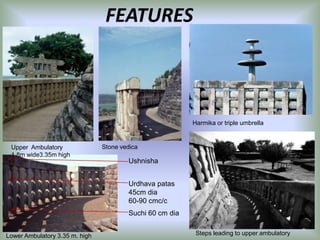
- Plan 4: B. Buddhist Stupa
Part B: Example of an Expert-Level Response
(Example comparing the Christian Basilica and the Islamic Mosque)
The spatial organizations of the Christian Basilica (Plan 1) and the Islamic Mosque (Plan 3) are fundamentally different because they are designed for different core religious activities: procession versus communal prayer. The Christian Basilica is a linear, hierarchical space defined by its powerful longitudinal axis. The long nave is designed to guide a congregation in a procession towards the altar at the apse, which is the single, sacred focal point for liturgical ceremony. This directional, processional journey is central to the form. In contrast, the Islamic Mosque is a non-hierarchical, expansive space. The hypostyle hall, with its grid of columns, creates a unified field that is horizontally expansive rather than vertically focused. The primary organizing principle is not a journey towards a point, but the shared orientation of the entire community towards the qibla wall for simultaneous, collective prayer. One plan is about a guided procession to a sacred object; the other is about collective unity facing a sacred direction.
Teacher's Notes (For Profiling)
1. Knowledge Points Tested:
- Architectural Typology (Archetype C/H): Recognition of the fundamental plan types of major world sacred architectures.
- Systems Thinking (Archetype S/C): The core skill of understanding how an invisible system (religious ritual, cosmology, belief) generates a physical, spatial organization. This aligns with analyzing complex processes or systems in IELTS Reading and providing nuanced explanations in Writing Task 2.
- Comparative Analysis: The ability to move beyond simple description to articulate the relationship between form and purpose across different examples. This skill is critical for IELTS Writing Task 1 (describing diagrams, comparing data) and Writing Task 2 (developing comparative arguments).
- Cultural & Historical Knowledge (Archetype H): Implicit understanding of the core worship practices of Christianity, Islam, Hinduism, and Buddhism, which enriches vocabulary and contextual understanding.
- Diagrammatic Literacy: The ability to interpret 2D architectural plans and understand their spatial implications. Directly relevant to IELTS Writing Task 1, where candidates must interpret and describe visual data.
- Academic Vocabulary & Cohesion (IELTS Specific): Ability to use appropriate terminology (e.g., 'longitudinal axis', 'hypostyle hall', 'cosmological beliefs') and organize ideas logically with cohesive devices.
2. Logical Pathways & Thought Patterns:
- Functional Deduction (First-Principles Logic): This is the highest-level architectural thinking. The student deduces the plan's logic from the function. "Worship in a mosque is communal and requires facing Mecca, so the plan must be a wide hall oriented towards one wall." "A Catholic mass is a procession led by a priest toward an altar, so the plan must be a long, axial hall with a clear focal point." The Part B answer for this student will be rich with cause-and-effect reasoning, demonstrating advanced analytical skills valuable in IELTS Writing Task 2.
- Typological Recall (Knowledge-Based): The student has studied these plan types and correctly identifies them from memory. Their Part B answer will be technically correct but may sound more like a textbook definition, stating *that* the plans are different without as much emphasis on *why*. This indicates good factual recall but potentially weaker analytical depth compared to functional deduction.
- Geometric Description (Surface-Level Analysis): The student analyzes the plans purely as shapes, failing to connect them to a deeper system of meaning. In Part B, they might write: "Plan 1 is a long rectangle shaped like a cross, while Plan 3 is a big square with lots of dots inside." This indicates a critical weakness in moving from form to purpose, a skill fundamental for both architectural thinking and high-scoring IELTS descriptive/analytical tasks.
- The "Look-Alike" Trap / Conflation: The student confuses plans with similar visual features. They might see the grid of columns in the mosque and the columns of the basilica's nave and equate them. They may confuse the mandala-like plans of the Hindu Temple and the Buddhist Stupa, failing to distinguish between a path to a central deity-chamber (Garbha Griha) and a path of circumambulation around a relic-mound (Stupa). This highlights issues with precise observation and differentiation, crucial for IELTS Reading detail questions.
3. Potential Hurdles & Common Errors:
- Vague Justification in Part B: Answers like "The plans are different because the religions are different" or "One is for praying and the other is also for praying." This demonstrates an inability to articulate specific architectural and functional differences, and a lack of developed ideas, which would severely impact the Task Response and Coherence/Cohesion scores in IELTS Writing.
- Focusing on Decoration, Not Plan: The student might try to answer based on what they know of the *elevation* or decoration of these buildings (e.g., "mosques have domes and minarets") instead of analyzing the provided floor plans. This shows a failure to adhere to task instructions, a common issue in IELTS.
- Misunderstanding "Hierarchy": Confusing visual complexity with spatial hierarchy. They may see the complex geometry of a Hindu temple plan as less hierarchical than the simple axis of a basilica, failing to understand that the progression towards the central garbha griha is a powerful hierarchical sequence. This points to a misunderstanding of core architectural concepts and a potential misinterpretation of visual data.
- Inability to Articulate Function: The student may correctly match the plans in Part A but cannot explain the *activity* that happens within them in Part B, revealing a gap between recognition and true understanding. This directly impacts their ability to elaborate and support points in IELTS writing.
- Word Count Deficit (IELTS Specific): For Part B, students failing to meet the "at least 150 words" requirement indicates issues with idea generation, development, or fluency, which would result in a penalty in IELTS Writing Task 2.
Rubric for Assessment
| Dimension | Level 1: Novice | Level 2: Developing | Level 3: Proficient | Level 4: Expert |
|---|---|---|---|---|
| Plan Identification (Questions 1-4) | Correctly identifies 0-1 plan. Evidence of random guessing. | Correctly identifies 2-3 plans, often confusing the more geometrically similar ones. | Correctly identifies all 4 plans. | Correctly identifies all 4 plans with confidence and speed. |
| Comparative Analysis (Questions 5-8) | Provides a purely geometric description of the shapes ("long rectangle vs. square") or a tautological reason ("They are different because the buildings are different"). Fails to meet word count. | Can describe the primary function of one plan type, or describes both in very generic terms ("They are for worship"). Limited architectural vocabulary. May struggle with word count. | Clearly explains the different spatial organization and links it to a correct, distinct function for both chosen plans. Uses some appropriate architectural vocabulary. Meets word count. | Explains the different spatial organizations with precision, using advanced architectural vocabulary (e.g., "longitudinal axis," "hypostyle hall," "processional journey") and explicitly linking them to the core theological or ritualistic purpose (e.g., "processional vs. communal worship"). Demonstrates excellent coherence and cohesion, exceeding word count with relevant detail. |
| Systems Thinking (Architecture & IELTS) | Sees the plans as static, abstract patterns, unable to infer underlying purpose. | Recognizes that the plans are for different religions but cannot explain how the belief system *shapes* the space or how form follows function. | Demonstrates a clear understanding that form follows function in sacred architecture, making reasonable inferences from visual data. | Articulates how the entire spatial system of each plan is a direct physical manifestation of an underlying invisible system of belief, ritual, and cosmology. Shows strong inferential reasoning, similar to high-level IELTS Reading skills. |
| Language & Vocabulary (IELTS Specific) | Limited range of vocabulary; frequent grammatical errors; difficulty expressing complex ideas. | Adequate vocabulary for simple descriptions; some grammatical errors that may impede meaning. | Good range of vocabulary, including some architectural terms; minor grammatical errors. Clear and understandable. | Wide range of precise vocabulary, including advanced architectural and analytical terms; high grammatical accuracy; demonstrates control over complex sentence structures for clarity and impact. |