Architectural Assessment: Component & Context
Architectural Assessment
Component Identification & Functional Analysis for Architecture & IELTS Preparation
This section tests your ability to understand and describe key architectural components. Pay close attention to visual details and articulate your answers clearly and concisely, similar to the demands of the IELTS exam.
Question 5: The Anatomist's Atlas - Component & Context
Part A: Matching Components to Images (Questions 1-5)
An architect must recognize not just whole buildings, but the critical components that make them work. Match each of the architectural components (A-E) with the image (1-5) that best illustrates it. Write the correct letter (A-E) next to each image number. You will use each letter once only.

A clear, isolated diagram showing the central, wedge-shaped stone at the apex of a stone arch, locking the other stones in place.

A detailed photograph of a large, circular stained-glass window with intricate radial mullions, typical of a Gothic cathedral facade.

A cross-section diagram showing a row of windows placed high on a wall, above eye level, with arrows indicating light penetration and warm air rising.
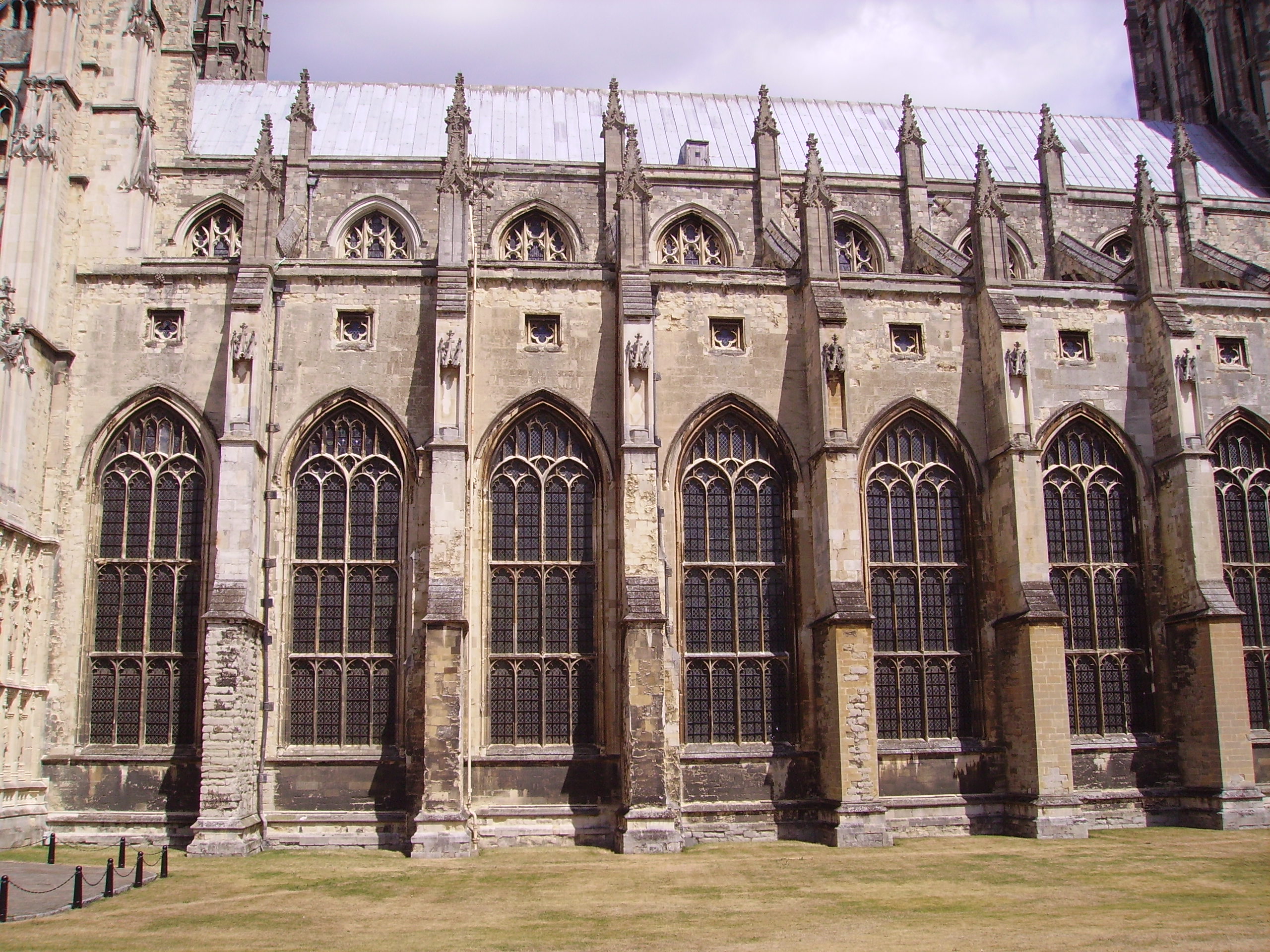
An exterior photograph of a cathedral, showing an arched stone support that stands apart from the main wall but connects to it at the top.
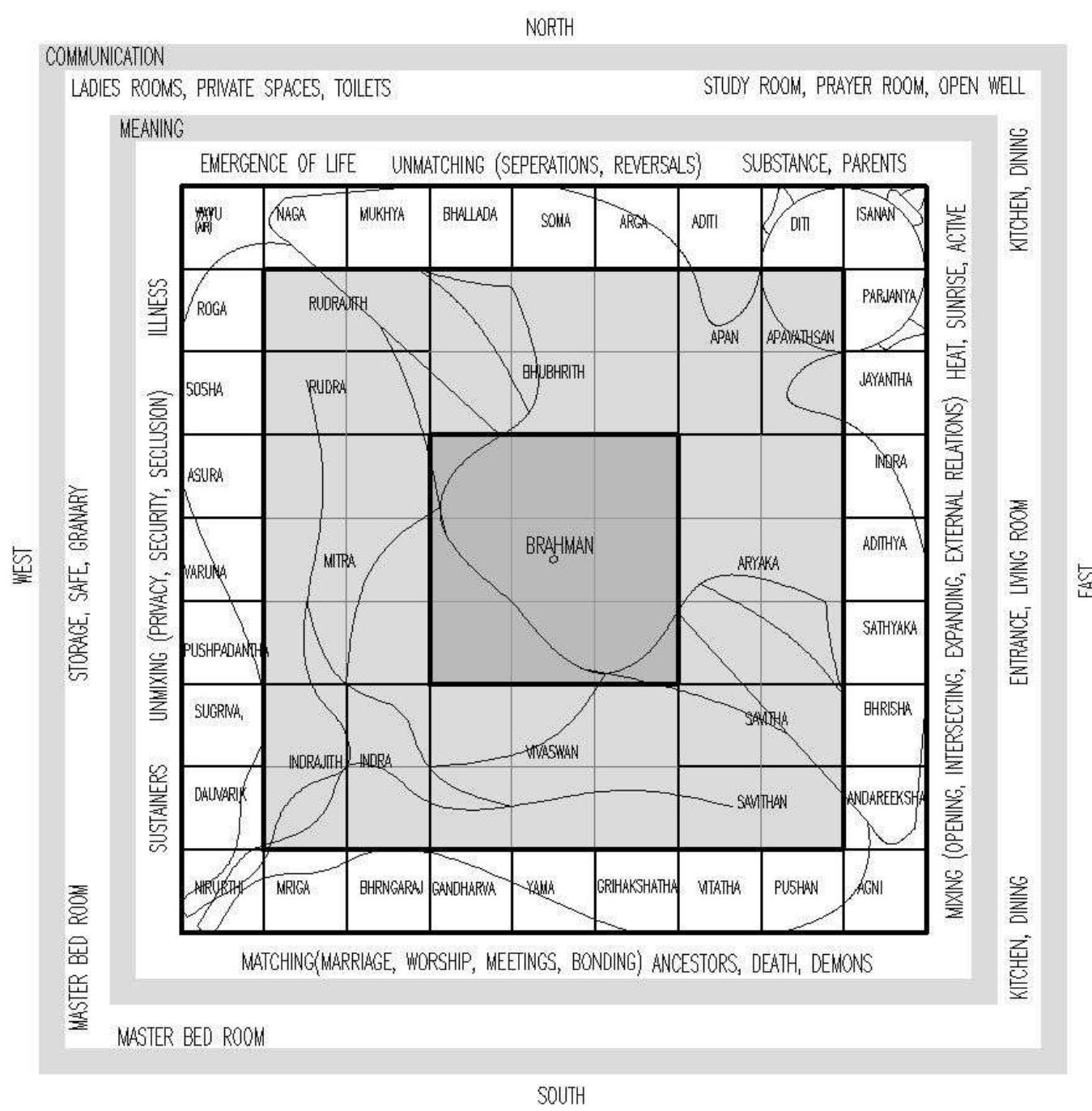
A schematic plan diagram showing a grid with a stylized, cosmic human form overlaid, used for determining proportions and layout.
- A. Clerestory
- B. Flying Buttress
- C. Keystone
- D. Rose Window
- E. Vastu Purusha Mandala
1. Image 1:
2. Image 2:
3. Image 3:
4. Image 4:
5. Image 5:
Part B: Functional Analysis (Questions 6-7)
From the list above, choose the Flying Buttress and the Clerestory. For each, write one single, clear sentence explaining its primary function. Your answer for each should be NO MORE THAN ONE SENTENCE.
Instructor's Guide & Rubric [CONFIDENTIAL]
Instructor Materials: Question 5 Analysis
Model Answer / Solution
Part A: Correct Matches
- 1. Image 1: C. Keystone
- 2. Image 2: D. Rose Window
- 3. Image 3: A. Clerestory
- 4. Image 4: B. Flying Buttress
- 5. Image 5: E. Vastu Purusha Mandala
Part B: Ideal Responses
- 6. Flying Buttress Function: Its primary function is to resist the outward and downward thrust from the nave vaults, transferring that load away from the upper walls to external piers.
- 7. Clerestory Function: Its primary function is to admit light and/or air into the upper part of a tall space, often while allowing for the release of warm air that has risen.
Teacher's Notes (For Profiling & IELTS Connection)
1. Knowledge Points Tested (Architectural & IELTS):
- Architectural Vocabulary: Recognition of specific, technical components from different architectural traditions (Gothic, Roman/Structural, Environmental, Hindu/Vedic). This directly correlates with the "Lexical Resource" criterion in IELTS, particularly for academic subjects.
- Structural Literacy: Understanding of fundamental structural concepts (e.g., how an arch works with a Keystone, how lateral forces are managed in large masonry buildings with Flying Buttresses). This is a domain-specific knowledge point, which in an IELTS context, would be presented in a reading passage, testing comprehension of complex technical information.
- Environmental Systems Thinking: Understanding of passive design strategies for daylighting and ventilation (Clerestory). This tests analytical skills relevant to IELTS Reading sections discussing environmental or technical topics.
- Conceptual & Cultural Knowledge: Recognition of a non-Western organizational and cosmological diagram (Vastu Purusha Mandala). This broadens cultural literacy, a soft skill beneficial for understanding diverse texts in IELTS.
- Diagrammatic Interpretation: Ability to decode function and form from various 2D representations (photos, cross-sections, plans). This is a crucial skill for IELTS Academic Writing Task 1, where students often need to describe processes or diagrams.
2. Logical Pathways & Thought Patterns (IELTS Relevant):
- Contextual Association (Knowledge-Based): The student immediately recognizes the Rose Window and Flying Buttress as "Gothic." They see the Keystone and think "Arch." This indicates a well-organized mental library of architectural history and vocabulary, useful for quickly grasping meaning in IELTS reading passages.
- Functional Deduction (First-Principles Logic): The student may not know the term "Flying Buttress" but sees its form and deduces its purpose. For Part B, they might write: "It's a support on the outside to stop the tall walls from falling over." This demonstrates powerful analytical reasoning and inferential skills, highly valued in IELTS Reading.
- Visual Matching (Surface-Level): The student matches the most obvious visual forms. They see a round window and correctly match "Rose Window." This tests attention to detail and ability to locate specific information, a common IELTS Reading task.
- Random Guessing: The student has little to no familiarity with these terms and their answers show little logical connection. This indicates a gap in both architectural knowledge and potentially a struggle with critical thinking under pressure, which would impact IELTS performance across all sections.
3. Potential Hurdles & Common Errors (IELTS Relevance):
- Generic Descriptions of Function: In Part B, providing a vague answer like "A buttress is for support" or "A clerestory is for light." This fails to capture the *specific* way the component works and demonstrates a lack of precision in vocabulary and sentence structure, which would negatively impact IELTS Writing (Task Achievement, Lexical Resource, Grammatical Range and Accuracy).
- Confusing Clerestory with any window: The defining feature of a clerestory is its high placement on a wall that rises above an adjoining roofline. This shows a lack of understanding of specific details, affecting performance in IELTS Reading questions requiring precise factual identification.
- Misinterpreting the Mandala: Viewing the Vastu Purusha Mandala as a purely decorative pattern without understanding its role as a proportional and cosmological guide. This indicates a struggle with abstract or culturally specific concepts, which can appear in IELTS Reading passages.
- Exceeding Word Count (Part B): Writing more than "one single, clear sentence" for Part B, even if the content is correct. This is a direct test of following instructions and conciseness, a critical skill for IELTS Writing and Short Answer questions.
Rubric for Assessment
| Dimension | Level 1: Novice | Level 2: Developing | Level 3: Proficient | Level 4: Expert |
|---|---|---|---|---|
| Component Identification (Part A) | Correctly matches 0-1 component. Evidence of random guessing or significant misunderstanding. | Correctly matches 2-3 components, typically the most visually obvious ones (e.g., Rose Window, Keystone). Shows some ability for visual recognition. | Correctly matches 4-5 components, demonstrating strong visual vocabulary, possibly with minor confusion on abstract or technical items. | Correctly matches all 5 components with confidence and accuracy. Demonstrates a comprehensive visual and verbal architectural vocabulary. |
| Functional Analysis (Part B) | Explanations are incorrect, tautological ("A buttress is for buttressing"), absent, or significantly exceed the sentence limit without clear purpose. Demonstrates weak comprehension and poor adherence to instructions. | Explains the functions in very generic terms ("support," "light") and might slightly exceed the sentence limit. Shows basic understanding but lacks technical precision and conciseness. | Explains both components' primary functions correctly and clearly within the "one sentence" limit. Demonstrates good understanding and ability to articulate it concisely. | Explains both functions with scientific and architectural precision, using key terms like "lateral thrust," "nave vaults," "daylighting," and "convective ventilation," all within the "one sentence" limit. Shows advanced vocabulary and grammatical control. |
| Systems Thinking & IELTS Integration | Unable to interpret the diagrams beyond their surface appearance or connect component function to a larger system. Answers show limited lexical range and grammatical control. | Recognizes the components as objects but struggles to articulate their role within a larger system (structural, environmental, or cultural) or uses simple, repetitive language. Does not fully meet the conciseness requirement. | Can explain the function of the individual components correctly and implies their systemic role. Answers are coherent and meet the basic linguistic requirements for clarity and conciseness. | The explanations in Part B demonstrate a clear understanding of how each component is part of an integrated system of forces, light, or cultural order. This reflects strong analytical skills and academic language proficiency, aligning well with high-level IELTS task achievement and lexical resource. |