IELTS-Style Diagnostic Test: Architectural Aptitude & Environmental Design
IELTS-Style Diagnostic Assessment
Architectural Aptitude & Environmental Design (Preparing for UK University Admission)
This diagnostic test assesses your foundational knowledge in architecture, reasoning skills, and analytical thinking, all while practicing formats typical of the IELTS exam. Please read all instructions carefully and adhere to word limits.
Section 1: The Globalist's Codex - Monumental Arches
Questions 1-3: Matching Information
Look at the three images of monumental arches (Image 1-3). Choose the correct name for each arch from the list below and write it in the corresponding space. Each name can only be used once.



1. Image 1:
2. Image 2:
3. Image 3:
Questions 4-6: Short Answer Questions
For each image, briefly describe the single most important visual clue or detail you used to distinguish it from the others. Write NO MORE THAN TEN WORDS for each answer.
4. Image 1 Clue:
5. Image 2 Clue:
6. Image 3 Clue:
Section 2: The Systems Thinker - Invisible Forces
The following diagrams illustrate two different passive design principles used to regulate temperature in a building.

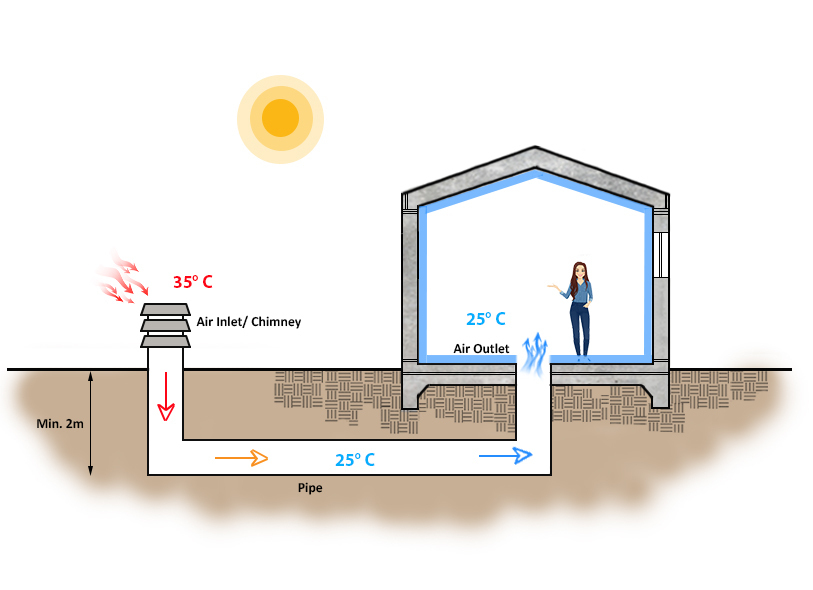
Questions 7-8: Sentence Completion
Complete the sentences below. Write ONE WORD ONLY for each answer.
7. The scientific name for the principle shown in Diagram A is the __________ effect.
8. The architectural technique shown in Diagram B is known as an earth-air __________.
Questions 9-10: Short Answer Questions
For both diagrams, explain the core physical principle that makes the system work. Write NO MORE THAN TWENTY WORDS for each answer.
9. Diagram A Principle:
10. Diagram B Principle:
Instructor's Guide & Profiling Matrix [CONFIDENTIAL]
Instructor Materials: Section 1 Analysis (IELTS-Style Matching Information & Short Answer)
Model Answer / Solution
Questions 1-3: Matching Information
- 1. Image 1: Arc de Triomphe (Paris, France)
- 2. Image 2: India Gate (New Delhi, India)
- 3. Image 3: Arch of Constantine (Rome, Italy)
Questions 4-6: Short Answer Questions
- 4. Image 1 Clue: Covered in complex, high-relief sculptures, military scenes. (8 words)
- 5. Image 2 Clue: Clean form, inscribed names, small chhatri-like top. (8 words)
- 6. Image 3 Clue: Three archways, ancient stone, multiple distinct reliefs. (7 words)
Teacher's Notes (For Profiling)
1. Knowledge Points Tested:
- Architectural History (Archetype H): Recognition of three of the world's most famous monumental arches from different historical and cultural contexts (French Neoclassicism, British Imperial/Indo-Saracenic, Roman Empire).
- Visual Literacy (IELTS Reading Skill): The ability to observe and identify specific, defining architectural details rather than relying on general forms. This directly transfers to interpreting diagrams and visual information in IELTS Reading.
- Architectural & General Vocabulary (IELTS Language Skill): Implicit understanding and potential use of terms like "sculptural relief," "inscription," and "archway," which are important for academic writing and speaking.
2. Logical Pathways & Thought Patterns:
- Global Recognition (Intuitive-Fast): The student immediately recognizes the Arc de Triomphe as a famous landmark. Their identification of the other two may be less certain, relying on guessing or partial knowledge.
- Comparative Analysis (IELTS Reading Strategy): The student actively compares the three images, looking for points of difference (number of arches, style of decoration, apparent age). This is a key strategy for "Matching Information" or "Locating Information" tasks in IELTS Reading.
- The "One Detail Rule" (Strategic Elimination): The student consciously searches for a single, definitive feature to make the identification. This demonstrates systematic problem-solving applicable to many IELTS question types.
3. Potential Hurdles & Common Errors:
- The "Look-Alike" Trap: Confusing the Arc de Triomphe and India Gate due to their similar single-arch form. Highlights a need for detailed observation.
- Vague Justification (IELTS Writing/Speaking Issue): In Questions 4-6, providing generic clues like "it's a big arch" or "it looks old." This indicates a struggle with precise, concise description, a common challenge in IELTS Writing Task 1.
- Exceeding Word Limit (IELTS Test-Taking Error): Listing many details instead of the "single most important" one, or failing to adhere to the "NO MORE THAN TEN WORDS" instruction. This points to a lack of conciseness and test strategy.
Rubric for Assessment: Section 1
| Dimension | Level 1: Novice | Level 2: Developing | Level 3: Proficient | Level 4: Expert |
|---|---|---|---|---|
| Identification Accuracy (Q1-3) | Identifies 0-1 arches correctly. | Identifies 2 arches correctly, often confusing Paris and Delhi, or struggles with unique identification. | Identifies all 3 arches correctly, demonstrating general architectural literacy. | Identifies all 3 arches correctly with confidence and without hesitation. |
| Analytical Process & Description (Q4-6) | Justification is generic ("It's a big arch"), incorrect, absent, or significantly exceeds word limit. | Provides a clue, but it is not the most definitive one (e.g., "It has writing on it") or slightly exceeds word limit. | Provides a clear, correct, and concise distinguishing feature for each arch, adhering to the word limit. | Provides a highly specific feature, perhaps using advanced architectural vocabulary ("high-relief sculptural program"), adhering strictly to the word limit, demonstrating precision. |
| Strategic Thinking (IELTS Relevance) | Approach appears to be random guessing; ignores instructions like "only once" or word limits. | Relies on general recognition of the most famous example; struggles with comparative analysis; might disregard word limits. | Applies a systematic comparison of features; attempts to adhere to "only once" and word limits, showing nascent IELTS test-taking skills. | Consciously applies an elimination strategy to efficiently distinguish the monuments; demonstrates strong adherence to all instructions and word limits, akin to efficient IELTS test-takers. |
Instructor Materials: Section 2 Analysis (IELTS-Style Sentence Completion & Short Answer)
Model Answer / Solution
- 7. The scientific name for the principle shown in Diagram A is the stack effect.
- 8. The architectural technique shown in Diagram B is known as an earth-air tunnel.
- 9. Diagram A Principle: Warm air rises, creating suction for cool air to enter below. (9 words)
- 10. Diagram B Principle: Earth's stable temperature pre-cools/heats air entering building. (9 words)
Teacher's Notes (For Profiling)
1. Knowledge Points Tested:
- Systems Thinking (Archetype S/M): Ability to recognize and understand invisible environmental systems within architectural design.
- Architectural Terminology (IELTS Language Skill): Knowledge of specific terms like "Stack Effect" and "Earth-Air Tunnel," crucial for academic discourse in architecture.
- Physics & Environmental Science: Basic understanding of convection and geothermal heat exchange, essential for sustainable design.
- Diagrammatic Interpretation (IELTS Reading Skill): The skill of decoding information from a technical cross-section diagram, directly relevant to IELTS Reading Task 1 (describing a process or diagram).
2. Logical Pathways & Thought Patterns:
- Memorized Recall: The student has studied these concepts and immediately provides the correct terminology and explanations.
- Deductive Reasoning: The student may not know the formal name but can logically deduce the function and core principle from the visual evidence (e.g., describes "hot air rising" for Diagram A). This showcases analytical thinking.
- Surface-Level Description: The student simply describes what they see in the diagram ("Arrows show air moving up") without interpreting the underlying system or adhering to word limits. This suggests a lack of deeper understanding or difficulty in articulation.
3. Potential Hurdles & Common Errors:
- Vague Terminology (IELTS Vocabulary Issue): Using generic terms like "cooling system" or "ventilation" instead of precise technical names.
- Incorrect Physics: Misunderstanding *why* the system works (e.g., "wind pushes the air out" for Diagram A), indicating gaps in scientific foundational knowledge.
- Inability to Articulate Concisely (IELTS Writing Skill): The student may intuitively understand the concept but lack the precise vocabulary or sentence structure to explain it clearly and within the specified word limit. This is a direct measure of IELTS Writing Task 1 readiness.
- Exceeding Word Limits (IELTS Test-Taking Error): Failing to adhere to "ONE WORD ONLY" or "NO MORE THAN TWENTY WORDS," demonstrating a lack of attention to detail and test instructions.
Rubric for Assessment: Section 2
| Dimension | Level 1: Novice | Level 2: Developing | Level 3: Proficient | Level 4: Expert |
|---|---|---|---|---|
| Terminology Accuracy (Q7-8) | Cannot identify either system correctly or provides completely incorrect terms. | Identifies one system correctly, or uses a partially correct term (e.g., "natural ventilation" instead of "stack"). May not adhere to "ONE WORD ONLY." | Identifies both systems with their correct technical names (e.g., "stack," "tunnel"), adhering to "ONE WORD ONLY." | Identifies both systems precisely, considering nuances (e.g., clarifies "stack effect") and strictly adheres to "ONE WORD ONLY." |
| Systemic Understanding & Explanation (Q9-10) | Describes only the visual elements ("The arrows go up") or provides incorrect principles; significantly exceeds word limit. | Explains the principle for one system, or both in very simple terms ("Hot air rises"), possibly exceeding the word limit slightly. | Clearly and accurately explains the core physical principle for both systems within the "NO MORE THAN TWENTY WORDS" limit. | Explains the principles for both systems with scientific precision and excellent conciseness, using appropriate academic vocabulary, well within the word limit. |
| Problem-Solving Approach (IELTS Relevance) | Unable to interpret the diagrams beyond basic components; ignores word limits completely. | Can describe the function but struggles with the scientific cause or precise name; often exceeds word limits. | Correctly interprets the diagrams and identifies the systems, demonstrating learned knowledge and attempts to adhere to word limits. | Can deduce the principle from the diagram even without prior explicit knowledge, explaining the "why" from first principles, and masters all word limits, reflecting strong IELTS reading and summarizing skills. |