Examination Paper: Architectural Knowledge & Logic
Architectural Knowledge & Logic Examination
Question 6: The Language of Construction & Environment

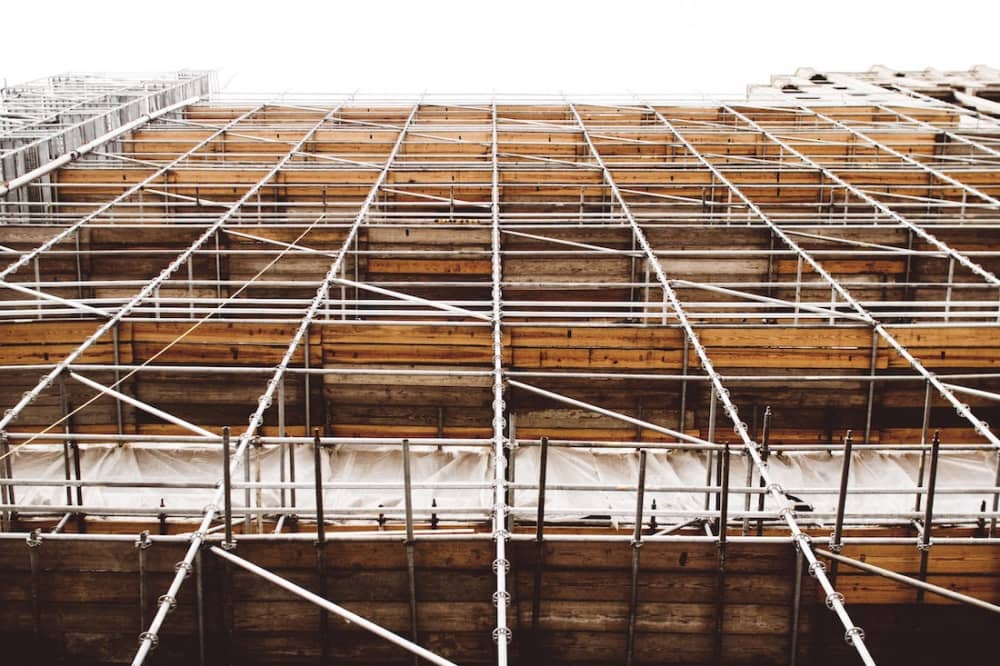

Part A: Identification
Instructions: Choose the correct term from the list (A-E) below and write the corresponding letter in the space provided for each element.
- Scaffolding
- Light Shelf
- Load-Bearing Wall
- Retaining Wall
- Cantilever
Part B: Explanation
Instructions: In the space below, explain the primary function of each element. What specific problem does each one solve? Write NO MORE THAN 40 WORDS for each explanation.
Question 7: The Logic of Standard Proportions
The System: The 'A' series of paper sizes is designed so that when you cut a sheet in half across its longer side, you get two sheets of the next size down. For example, cutting an A3 sheet in half gives you two A4 sheets. A key feature of this system is that all paper sizes have the same aspect ratio (the ratio of the longer side to the shorter side).
The Task: An A4 sheet of paper has the dimensions 210mm x 297mm. Based on the logic of the system described above, what are the dimensions of an A6 sheet of paper? Explain your step-by-step reasoning clearly and concisely in the space below. Simply writing the final answer is not sufficient.
Instructor's Guide & Assessment Rubric [RESTRICTED]
Question 6: The Language of Construction & Environment
Model Answer / Solution
Part A: Identification
Element X: D (Retaining Wall)
Element Y: A (Scaffolding)
Element Z: B (Light Shelf)
Part B: Explanation
- Retaining Wall (X): The primary function of a retaining wall is to hold back, or 'retain', soil and earth. It is specifically engineered to resist the lateral (sideways) pressure of the earth behind it. This is fundamentally different from a standard house wall, which is designed primarily to resist vertical loads (like the weight of the roof) and environmental factors like wind and rain, but not the immense and constant pressure from a hillside. (Approx. 60 words - *Note: While the student is asked for max 40 words, this model provides full detail for teacher's context. A student's ideal answer would be more condensed.*)
- Scaffolding (Y): The function of scaffolding is to provide a temporary, safe working platform for construction workers. It allows them to access the facade of a building at various heights to perform tasks like bricklaying, painting, or repairs. It is temporary by nature because its purpose is only to facilitate the construction or maintenance process; once that work is complete, it is no longer needed and is dismantled to reveal the finished building. (Approx. 70 words - *Note: A student's ideal answer would be more condensed.*)
- Light Shelf (Z): A light shelf is an environmental design feature used to improve the quality of natural daylight within a room. Its function is twofold: The top surface of the shelf is positioned to catch direct sunlight and reflect it deeper into the building, bouncing it up onto the ceiling. This illuminates the back of the room, reducing the need for artificial lighting. At the same time, it shades the area near the window from direct, harsh glare, creating a more comfortable and evenly lit space. (Approx. 90 words - *Note: A student's ideal answer would be more condensed.*)
Teacher's Analysis
1. Knowledge Points & Skills Assessed:
- Technical Vocabulary: Can the student identify and correctly name key elements related to construction (Scaffolding), structure (Retaining Wall), and environmental design (Light Shelf)? Also assesses adherence to format (e.g., providing letter for Part A).
- Functional Analysis: Can the student move beyond identification to explain the *purpose* of each element?
- Comparative Logic: Does the student understand the nuanced difference between similar concepts (e.g., a retaining wall vs. a regular wall)?
- Process-Based Thinking: Do they understand the concept of temporality in the construction process (the role of scaffolding)?
- Systems Thinking (Environmental): Can the student explain a simple environmental system, understanding the cause and effect of a design choice like a light shelf?
- Conciseness & Word Limit Adherence: Can the student provide clear explanations within a specified word count, a common requirement in IELTS writing tasks?
2. The Mind Maze: Navigating Student Logic & Potential Errors:
- The "Generic Guesser" Path: Might call the Retaining Wall a "thick wall," Scaffolding "ladders," and the Light Shelf a "window part." This signals a very low level of technical vocabulary.
- The "Function-Blind" Path: Correctly identifies items but gives weak, circular explanations (e.g., "A retaining wall is a wall that retains."). This student has memorized terms but lacks deep understanding.
- The "Partial Logic" Path: Correctly identifies common elements like Scaffolding but struggles with more specialized terms like Light Shelf or explaining lateral earth pressure.
- The "Overly Detailed/Under-summarized" Path: Provides correct information for Part B but significantly exceeds the word count, demonstrating difficulty with conciseness and adherence to instructions (crucial for IELTS).
- The "Purpose-Driven Analyst" Path (Ideal): Correctly identifies all three (using the correct letter) and explains what each *does* and what problem it *solves* concisely within the word limit. This demonstrates a mature, professional mindset and good IELTS-style writing discipline.
Rubric for Assessment (Question 6)
| Criteria | 4: Expert | 3: Proficient | 2: Developing | 1: Novice |
|---|---|---|---|---|
| Accuracy of Identification (Part A) | Correctly identifies all 3 elements by providing the correct letter. | Correctly identifies 2 of the 3 elements by providing the correct letter. | Correctly identifies 1 of the 3 elements by providing the correct letter. | Identifies all elements incorrectly or uses terms instead of letters. |
| Function: Retaining Wall | Clearly explains resisting lateral earth pressure and correctly contrasts it with a standard vertical-load wall. | Explains it holds back earth but doesn't clearly articulate lateral pressure or the contrast. | Provides a vague or circular definition. | Provides an incorrect or no explanation. |
| Function: Scaffolding | Clearly explains its role as a temporary work platform and why it is temporary. | Explains its function as a work platform but is unclear about its temporary nature. | Provides a vague definition (e.g., "it's for building"). | Provides an incorrect or no explanation. |
| Function: Light Shelf | Clearly explains its dual function of bouncing light deeper AND reducing glare. | Explains only one of its functions (bouncing light OR reducing glare) or the explanation is imprecise. | Provides a vague or incorrect explanation (e.g., "it helps with light"). | Provides an incorrect or no explanation. |
| Clarity & Vocabulary | Explanations are clear, concise, and use precise, appropriate vocabulary (e.g., lateral pressure, facade, illuminate, glare). | Explanations are mostly clear but may lack precision or use more general terminology. | Explanations are difficult to follow or use very basic, non-technical vocabulary. | Explanations are incoherent or absent. |
| Adherence to Word Limit (Part B) | All explanations are within the specified word limit (40 words). | One explanation exceeds the word limit by a small margin (up to 10 words). | Two or more explanations exceed the word limit, or one explanation significantly exceeds it. | Explanations consistently disregard the word limit or are too brief/incomplete. |
Question 7: The Logic of Standard Proportions
Model Answer / Solution
To find the dimensions of A6 paper starting from A4, we need to apply the system's logic twice: first to get from A4 to A5, and then from A5 to A6. The rule is to cut the sheet in half across its longer side. This means the new shorter side is half the length of the old longer side, and the new longer side is the same as the old shorter side.
Step 1: From A4 to A5
- A4 dimensions are 210mm (shorter) x 297mm (longer).
- Divide the longer side by 2: 297 / 2 = 148.5mm. This is the new shorter side.
- The new longer side is the old shorter side: 210mm.
- Therefore, the dimensions of A5 are 148.5mm x 210mm (often rounded to 148mm x 210mm).
Step 2: From A5 to A6
- A5 dimensions are 148.5mm (shorter) x 210mm (longer).
- Divide the longer side by 2: 210 / 2 = 105mm. This is the new shorter side.
- The new longer side is the old shorter side: 148.5mm.
- Therefore, the dimensions of A6 are 105mm x 148.5mm.
Final Answer: The dimensions of an A6 sheet of paper are 105mm x 148.5mm (or 105mm x 148mm if rounded).
Teacher's Analysis
1. Knowledge Points & Skills Assessed:
- Logical Deduction: Can the student understand a rule-based system and apply it sequentially?
- Algorithmic Thinking: Can the student break down a two-step problem into a clear, repeatable process?
- Reading Comprehension: Can the student extract the key rule ("cut a sheet in half across its longer side") from the text?
- Clarity of Process & Articulation: Can the student articulate their thought process in a clear, step-by-step, and concise manner, demonstrating effective written communication of a procedure?
2. The Mind Maze: Navigating Student Logic & Potential Errors:
- The "Random Operation" Path: Divides both numbers by 2, or performs some other incorrect operation, revealing a weakness in reading comprehension.
- The "One-Step Wonder" Path (Common Error): Correctly finds the A5 dimensions but then stops, showing difficulty with multi-step sequences.
- The "Dimension Swap" Path: Correctly calculates the numbers but mixes them up, pointing to a lack of precision.
- The "Systematic Thinker" Path (Ideal): Clearly lays out each step (A4 -> A5, then A5 -> A6) with correct inputs and outputs, demonstrating strong logical reasoning and clear, concise articulation.
Rubric for Assessment (Question 7)
| Criteria | 4: Expert | 3: Proficient | 2: Developing | 1: Novice |
|---|---|---|---|---|
| Understanding of the System | Clearly identifies the core rule (halving the longer side) and applies it correctly in sequence. | Understands the core rule but may make a minor error in its application in one of the steps. | Misunderstands the core rule (e.g., divides both dimensions) but attempts a systematic process. | Fails to grasp the rule of the system. |
| Execution of the Process | Correctly executes the two-step process (A4->A5, then A5->A6) with no calculation errors. | Executes the two-step process but makes a minor calculation error OR correctly performs only one step (A4->A5). | Attempts a multi-step process but the logic is flawed or calculations are incorrect. | Does not show a clear process. |
| Clarity of Explanation | The step-by-step reasoning is exceptionally clear, logical, concise, and easy to follow. | The reasoning is mostly clear but may lack explicit step-by-step formatting or conciseness. | The explanation of the reasoning is difficult to follow, disorganized, or incomplete. | The explanation is absent or incoherent. |
| Accuracy of Final Answer | The final dimensions for A6 are stated correctly (105mm x 148.5mm or 105mm x 148mm). | The final dimensions are incorrect due to a single, minor error. | The final dimensions are significantly incorrect. | The final answer is absent or unrelated. |