Examination Paper
ARCHITECTURAL ASSESSMENT
Module 2: Materials & Climate
IELTS Practice: Architecture & Environment
Questions 7-8 are based on the following information related to architectural design principles and material science.
Read the following information and questions carefully. For each question, choose the best answer from the options A, B, C or D and mark it on your answer sheet.
Instructions:
- Read each question and the accompanying text/image carefully.
- Choose ONE letter A, B, C or D for each answer.
- You should spend about 3-5 minutes on these questions.
Question 7
The image shows the Gando Primary School in Burkina Faso, designed by architect Diébédo Francis Kéré. The building is celebrated for its innovative and sustainable design that responds to the hot, dry climate. A key feature is its dual-roof system: a massive barrel vault forms the main ceiling, but high above it, a thin, raised metal roof acts like a canopy.
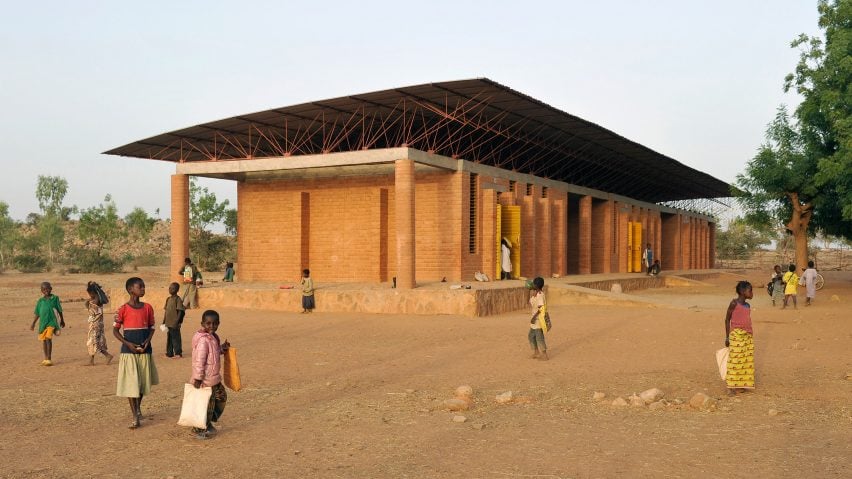
What is the primary climatic function of this elevated secondary roof? Choose ONE letter A, B, C or D.
Question 8
Architects must be precise in their understanding of materials. The four building materials listed below are all types of stone used in construction, but one is fundamentally different from the others in terms of its geological origin.
List of Materials:
- Shale
- Marble
- Limestone
- Sandstone
Which one is the "odd one out"? Choose ONE letter A, B, C or D.
Instructor's Guide & Profiling Key [CLASSIFIED]
Question 7: Analysis & Key
Question Dissection
- Core Concept: Climate-Responsive Design & Passive Cooling Strategies. This question assesses the student's ability to analyze a specific architectural feature and understand its performance-based rationale, specifically in the context of a hot climate. This skill is critical for interpreting technical and scientific passages in IELTS Reading.
- Knowledge Points:
- Understanding of basic thermal principles: solar heat gain, convection (hot air rises), and shading.
- The ability to identify the "thermal chimney" or "stack effect" principle – a specific piece of architectural vocabulary.
- The ability to differentiate between a primary function and a potential secondary benefit or a plausible but incorrect function, a key skill for IELTS multiple-choice questions.
- Analyze the Visuals and Context: The image shows a building in a hot climate (Burkina Faso) with a distinct double roof. There is a large air gap between the two roofs. The top roof is thin and metallic, while the lower one is thick and massive. In IELTS Reading, this step corresponds to quickly scanning the text and any visual aids to grasp the general topic and context.
- Evaluate the Primary Purpose: Why would an architect add this expensive second element? It must serve a crucial function. Given the climate, that function is almost certainly related to heat. This is akin to identifying the main idea or purpose of a paragraph in IELTS Reading.
- Analyze the Options:
- A) Solar Panels: While a roof can be used for solar panels, this is rarely the primary reason for its specific shape or elevation, especially in this "fly-roof" configuration. It's a possible secondary use, not the core design driver. In IELTS, this is a common distractor – something that is *possible* but not the *primary* or *correct* answer given the text.
- B) Rainwater Collection: A large, single roof would collect rainwater. Elevating it this way isn't the most efficient method for collection; in fact, it complicates the guttering. This is not its primary purpose. Another IELTS distractor, often using words from the passage but misrepresenting the main point.
- C) Sun Protection & Cooling: This option describes two related thermal effects. The top roof acts as a giant umbrella, shading the main roof from direct solar radiation, which dramatically reduces heat gain. The air in the gap between the roofs gets super-heated, causing it to rise. This rising air pulls cooler air from the classrooms below up and out, creating a natural ventilation system. This is a classic and highly effective passive cooling strategy, and it perfectly explains the design. This demonstrates a deep comprehension of the described system and its benefits.
- D) Acoustic Barrier: A thin metal roof would be notoriously loud in a heavy rain. It would amplify the sound, not dampen it. A massive, heavy roof would be a better acoustic barrier. This is functionally incorrect. This type of option tests both factual knowledge and the ability to critically evaluate statements, a key part of IELTS True/False/Not Given and multiple-choice questions.
- Conclusion: The design is a direct and intelligent response to the hot climate, using principles of shading and natural convection. Therefore, C is the correct answer. This mirrors the final stage of IELTS multiple-choice, where careful consideration of all options leads to the most accurate answer.
Potential Pitfalls & Student Thought Patterns
- The "Plausible Secondary Function" Trap: A student might see a flat surface and think "solar panels" (A) or "rainwater collection" (B) because these are common functions of roofs. This shows an inability to distinguish between a possible use and the primary design intent that dictates the form. They are not asking "Why this specific form?". In IELTS, this indicates difficulty identifying the main purpose or distinguishing between supporting details and the core argument.
- The "Aesthetic Guess": A student without knowledge of climate design might assume the roof is for visual effect or some other non-performative reason, leading to a random guess. This highlights a lack of relevant background knowledge, which can impede comprehension in IELTS academic texts.
- Misunderstanding of Material Properties: Choosing (D) indicates a fundamental lack of understanding of how materials behave. A thin metal sheet is a drum, not a sound barrier. This reveals a weakness in connecting material choice to physical performance, a critical aspect of understanding technical vocabulary and concepts in IELTS.
Profiling Rubric: Question 7
| Student's Answer | Performance Level | Student Profile Descriptor & Analysis |
|---|---|---|
| C (Correct) | Exceeds Standard (4/4) | Performance Analyst / Climate-Responsive Thinker: The student correctly identifies the primary function of the architectural element, demonstrating a clear understanding of passive design strategies and the relationship between form, climate, and performance. This student would likely excel at IELTS Reading questions requiring detailed comprehension and inferential reasoning from technical passages. |
| A or B | Developing (2/4) | Functional Generalist: The student correctly identifies a possible function of a roof but fails to analyze the specific form and context to deduce the *primary* purpose. This suggests a tendency to think in generalities rather than engaging in specific, context-driven problem-solving. In IELTS, this often leads to falling for distractors that are partially true but not the best fit. |
| D | Needs Improvement (1/4) | Material Misconception / Knowledge Gap: The student makes a choice that is counter to the physical properties of the materials shown. This indicates a significant gap in the understanding of how materials perform and the fundamentals of building science. This student may struggle with vocabulary, factual recall, and understanding cause-and-effect relationships within IELTS technical texts. |
Question 8: Analysis & Key
Question Dissection
- Core Concept: Material Classification by Geological Origin. This question tests the student's specific knowledge of common building stones and their ability to apply a scientific classification system to identify the outlier. This is akin to vocabulary-in-context or classification tasks in IELTS Reading.
- Knowledge Points:
- The three basic types of rock: Sedimentary, Metamorphic, and Igneous – essential architectural and geological vocabulary.
- Classification of Shale, Limestone, and Sandstone as Sedimentary rocks.
- Classification of Marble as a Metamorphic rock.
- The understanding that Marble is formed from Limestone under intense heat and pressure – demonstrating an understanding of processes, useful for IELTS flowchart or diagram questions.
- Analyze the Task: The goal is to find the material that does not belong with the other three based on "geological origin." This requires knowing how these rocks are formed. In IELTS, this means carefully reading the question type and identifying the specific criteria for selection.
- Define the Options' Origins:
- Shale is a Sedimentary rock, formed from compacted mud and clay.
- Limestone is a Sedimentary rock, formed primarily from the skeletal fragments of marine organisms like coral and mollusks.
- Sandstone is a Sedimentary rock, formed from cemented grains of sand.
- Marble is a Metamorphic rock. It is formed when limestone is subjected to the heat and pressure of metamorphism.
- Identify the Outlier: Shale, Limestone, and Sandstone share a common origin type: they are all Sedimentary. Marble is the only Metamorphic rock on the list. This demonstrates the ability to categorize and identify exceptions, a skill applicable to various IELTS matching tasks.
- Conclusion: Marble is the "odd one out" because it is a metamorphic rock, while the others are sedimentary. Therefore, B is the correct answer.
Potential Pitfalls & Student Thought Patterns
- The "Surface Appearance" Trap: A student might try to classify the rocks based on appearance, texture, or common use. They might think, "Marble is smooth and used in fancy buildings, while the others seem more rough or common." While this might lead them to the right answer by coincidence, their reasoning is not based on the required "geological origin" principle. This reveals a reliance on aesthetic or cultural associations rather than scientific classification, a common pitfall in IELTS where synonyms or paraphrases can trick students who don't understand the core meaning.
- The "Incomplete Knowledge" Guess: The student may know one or two of the rock types but not all four, leading to a guess. For example, they might know that Limestone and Sandstone are sedimentary but be unsure about Shale, causing them to guess incorrectly. This highlights gaps in academic vocabulary, a direct measure in IELTS.
- The Limestone-Marble Confusion: A student might know that marble is related to limestone but be unclear on the relationship. This could cause them to group the two together and look for a different outlier, indicating a partial but imprecise understanding. In IELTS, this is similar to misunderstanding the nuanced relationship between concepts presented in a passage.
Profiling Rubric: Question 8
| Student's Answer | Performance Level | Student Profile Descriptor & Analysis |
|---|---|---|
| B (Correct) | Meets Standard (3/4) | Systematic Classifier: The student correctly applied the scientific principle of geological classification to identify the outlier. This demonstrates precise, factual knowledge and the ability to use abstract classification systems to solve a problem. This student possesses strong vocabulary and categorization skills crucial for excelling in IELTS Reading. |
| A, C, or D (by chance with faulty logic) | Developing (2/4) | Associative Reasoner / Surface-Level Matcher: The student may have arrived at an answer (correct or incorrect) based on non-scientific criteria like texture, color, or perceived "value." Their thought process is not aligned with the question's core requirement, indicating a need to apply more rigorous, systematic logic. This pattern suggests difficulty with detailed instructions and identifying the precise focus of an IELTS question. |
| A, C, or D (by guessing) | Needs Improvement (1/4) | Knowledge Gap: The student does not know the geological origins of these common building materials. The choice is likely a random guess, indicating a foundational gap in material science knowledge. This points to a significant challenge in academic vocabulary and general knowledge required to understand complex IELTS texts. |