Examination Paper
ARCHITECTURAL APTITUDE & ENGLISH PROFICIENCY DIAGNOSTIC
Section 2: The Logic of Making
Questions 3-4: Multiple Choice (Architectural Principles)
Read the following descriptions and examine the images carefully. For each question, choose the ONE best answer (A, B, C or D).
Time allowed: Approximately 5 minutes per question.
These questions assess your ability to understand complex descriptions of architectural structures and identify specific terminology, a key skill for both architectural studies and academic English examinations.
Question 3
The structure shown below is the Kurilpa Bridge in Brisbane, Australia. It is a pedestrian bridge known for its complex, web-like appearance. The bridge's stability is achieved through a sophisticated interplay of "push" and "pull" forces. Thick poles, which are always in compression (push), are held in place by a continuous network of thin cables, which are always in tension (pull). The compression poles do not touch each other; they "float" within the tension network.
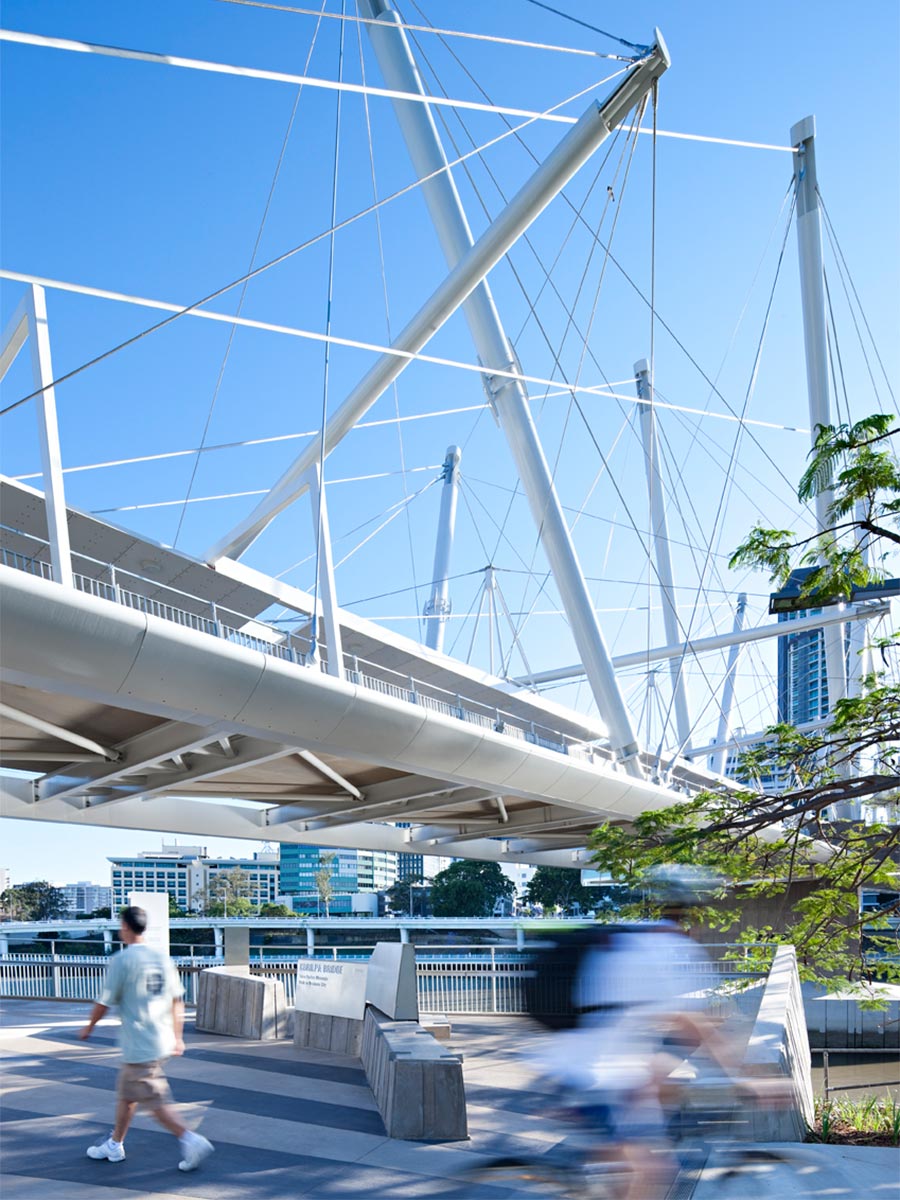
This structural system is a prime example of a:
Question 4
The image below shows a model created by the architect Antoni Gaudí to design the church of the Colònia Güell. Instead of drawing the arches, he hung a model of the floor plan upside down, attached strings to represent columns, and hung small weights from the strings to represent the loads of the structure. The resulting curves, formed purely by gravity, showed him the ideal shape for his arches. When this model is turned upright, the curves formed by the hanging chains are in pure compression, creating an incredibly strong and efficient arch.

This type of arch, derived from the natural curve of a hanging chain or string, is known as a:
Teacher's Analysis & Profiling Guide [RESTRICTED]
Overall IELTS Connection for this Section
This section primarily evaluates a student's **Architectural Vocabulary & Terminology** (Category 1) combined with **Reading Comprehension in a Design Context** (Category 2). For IELTS preparation, these questions are valuable for:
- Reading Skills: Identifying keywords, understanding contextual definitions, distinguishing between similar concepts based on detailed descriptions (e.g., distinguishing Tensegrity from Suspension).
- Lexical Resource: Assessing a student's existing vocabulary related to specialized architectural terms. The ability to correctly identify these terms demonstrates a strong academic lexicon.
- Attention to Detail: IELTS reading often requires precise understanding of details to select the correct option, which is critical in these questions.
- Inferencing: While direct definitions are provided, students must infer the best fit from the given options, requiring a level of critical thought.
Question 3 Analysis & Key
Question Dissection
- Core Concept: Differentiating advanced structural systems, specifically identifying Tensegrity. This question tests the student's ability to move past general appearances (a bridge with cables) and understand the specific, counter-intuitive logic of a tensegrity system.
- Knowledge Points:
- Definition of Tensegrity (tensional integrity): a system where isolated compression elements are held in a continuous tension network.
- Ability to visually distinguish this from Suspension (large primary catenary cables with vertical hangers) and Cable-Stayed (cables running directly from a tower to the deck) systems.
- Application of the "Push or Pull?" test described in the curriculum.
- Analyze the Description: The text provides a perfect definition of tensegrity: "compression poles do not touch each other; they 'float' within the tension network." This is the core identifying feature. The "push" (compression) and "pull" (tension) language is a direct giveaway.
- Analyze the Visuals: The image confirms the description. We can see masts that are not connected in a traditional frame but are instead held apart by a web of cables.
- Evaluate the Options:
- A) Suspension: Incorrect. A suspension bridge (e.g., Golden Gate) has massive, continuous cables draped between towers, with smaller vertical cables dropping to support the deck.
- B) Cable-Stayed: Incorrect. A cable-stayed bridge has towers with numerous cables running directly from the tower to various points on the deck, like a fan.
- C) Tensegrity: Correct. This system perfectly matches the description and the visual evidence of isolated compression elements in a tension network.
- D) Space Frame: Incorrect. A space frame is a three-dimensional truss where elements are all rigidly connected. The elements here are balanced in tension, not rigidly connected.
- Conclusion: The structure is a clear and famous example of tensegrity.
Potential Pitfalls & Student Thought Patterns
- The "Bridge with Cables" Trap (Over-simplification): Student sees cables and immediately jumps to the most common bridge types, Suspension (A) or Cable-Stayed (B). This indicates a failure to read the detailed description and analyze the specific arrangement. (IELTS Connection: Lack of attention to detail, skim-reading without comprehension).
- Vocabulary Gap: The student may understand the principle being described but may not know the term "Tensegrity." (IELTS Connection: Limited Lexical Resource in a specialized domain).
- Ignoring the Text: A student who relies purely on the image without reading the detailed explanatory text is much more likely to fall into the traps above. (IELTS Connection: Poor reading comprehension strategy, not using textual evidence effectively).
Profiling Rubric: Question 3
| Student's Answer | Performance Level | Student Profile Descriptor & Analysis |
|---|---|---|
| C (Correct) | Exceeds Standard (4/4) | System Deconstructor / Close Reader: The student correctly synthesized the textual description and visual information to identify the unique principle of Tensegrity. They can differentiate between complex but distinct structural systems, avoiding common traps. (IELTS Insight: Demonstrates strong ability to process specific details from a reading passage and apply domain-specific vocabulary accurately.) |
| A or B | Developing (2/4) | Category Generalist / "Shape Matcher": The student fell for the "Bridge with Cables" trap, lumping this highly specific system in with more common bridge types. Reveals a tendency to rely on general categories rather than precise analysis. (IELTS Insight: Suggests a weakness in distinguishing between closely related concepts based on nuanced textual information; may struggle with "True/False/Not Given" or specific detail questions.) |
| D | Needs Improvement (1/4) | Knowledge Gap: A space frame is a fundamentally different system. This choice suggests the student is unfamiliar with most or all of the systems listed and is making a random guess. (IELTS Insight: Indicates a significant gap in academic vocabulary and/or reading comprehension, potentially leading to frequent misinterpretations.) |
Question 4 Analysis & Key
Question Dissection
- Core Concept: Identifying the Catenary Arch and understanding its form-finding process. This question assesses whether the student can connect a specific design methodology (the hanging chain model) to the correct architectural term and principle.
- Knowledge Points:
- Definition of a Catenary Arch: The shape a free-hanging chain makes under its own weight. When inverted, the shape carries loads purely in compression.
- Knowledge of Antoni Gaudí's unique design methods.
- Ability to differentiate this from other arch types based on their geometry.
- Analyze the Process: The description is key. It explains a process of hanging weights on strings and letting gravity define the shape. The text explicitly states this shape is the "natural curve of a hanging chain or string."
- Understand the Principle: The text explains that when this shape is inverted, it works in pure compression. This is the fundamental structural advantage of this specific arch type.
- Evaluate the Options:
- A) Semicircular Arch: Incorrect. A simple half-circle, not derived from this process.
- B) Pointed Arch: Incorrect. A hallmark of Gothic architecture, constructed from two circular arcs.
- C) Parabolic Arch: A close but incorrect answer. A parabolic arch is mathematically similar and efficient, but the specific shape formed by a hanging chain is, by definition, a catenary.
- D) Catenary Arch: Correct. This is the precise technical term for the curve formed by a hanging chain under its own weight, as described in the prompt.
- Conclusion: The process and resulting form are the definition of a Catenary Arch.
Potential Pitfalls & Student Thought Patterns
- The "Looks Like an Arch" Guess: A student who doesn't know the specific terminology might guess A or B, the most common arch types they have learned about. (IELTS Connection: Limited specialized vocabulary, reliance on general knowledge rather than specific textual evidence).
- The Parabola/Catenary Confusion: A more advanced error. Choosing Parabolic (C) is a near miss, indicating good knowledge but a lack of precision. The key differentiator is the process described (hanging chain = catenary). (IELTS Insight: Struggles with distinguishing between closely related concepts, indicating a need for more precise vocabulary and understanding of definitions).
- Ignoring the Process: A student who only looks at the shape and doesn't understand the significance of the *method* will struggle to differentiate between C and D. (IELTS Connection: Failure to extract and utilize specific procedural information from the text, impacting reading comprehension).
Profiling Rubric: Question 4
| Student's Answer | Performance Level | Student Profile Descriptor & Analysis |
|---|---|---|
| D (Correct) | Meets Standard (3/4) | Process-to-Form Connector: The student correctly identified the Catenary Arch, demonstrating they understand the link between Gaudí's unique design process and the resulting structural form. (IELTS Insight: Successfully extracts key information about a process and matches it to the correct specialized term; strong reading comprehension for definitions.) |
| C | Developing (2/4) | Informed-but-Imprecise: The student correctly identified a highly efficient arch type that is visually similar but missed the specific definition linked to the hanging chain model. Shows good knowledge but needs greater precision. (IELTS Insight: Demonstrates near-miss vocabulary and an inability to differentiate between very similar technical terms based on precise textual cues.) |
| A or B | Needs Improvement (1/4) | Knowledge Gap / Rote Memorizer: The student defaulted to more common, geometrically simpler arch types, unable to analyze the specific form-finding process described. (IELTS Insight: Significant gaps in both specialized vocabulary and the ability to interpret descriptive text for specific details, indicating foundational reading comprehension issues.) |