Architectural Analysis Examination
Architectural Analysis Examination
Preparing for Architecture Majors & IELTS Success
Instructions to Candidates
- This examination consists of two questions (Questions 8 and 9), each with two parts (A and B).
- Read the instructions for each part carefully before answering.
- For Part A, select the best option (A, B, C, or D) and write your answer in the space provided.
- For Part B, write your answer in the text box provided. Pay close attention to word limits where specified.
- Use clear, concise, and academically appropriate language. Your ability to interpret visual information and articulate your understanding is being assessed.
- You will have 30 minutes to complete this section.
Questions 8-9
Question 8: Architectural Style & Visual Identification
The images below show several key features and exteriors of buildings from a specific and highly influential period of architectural history.
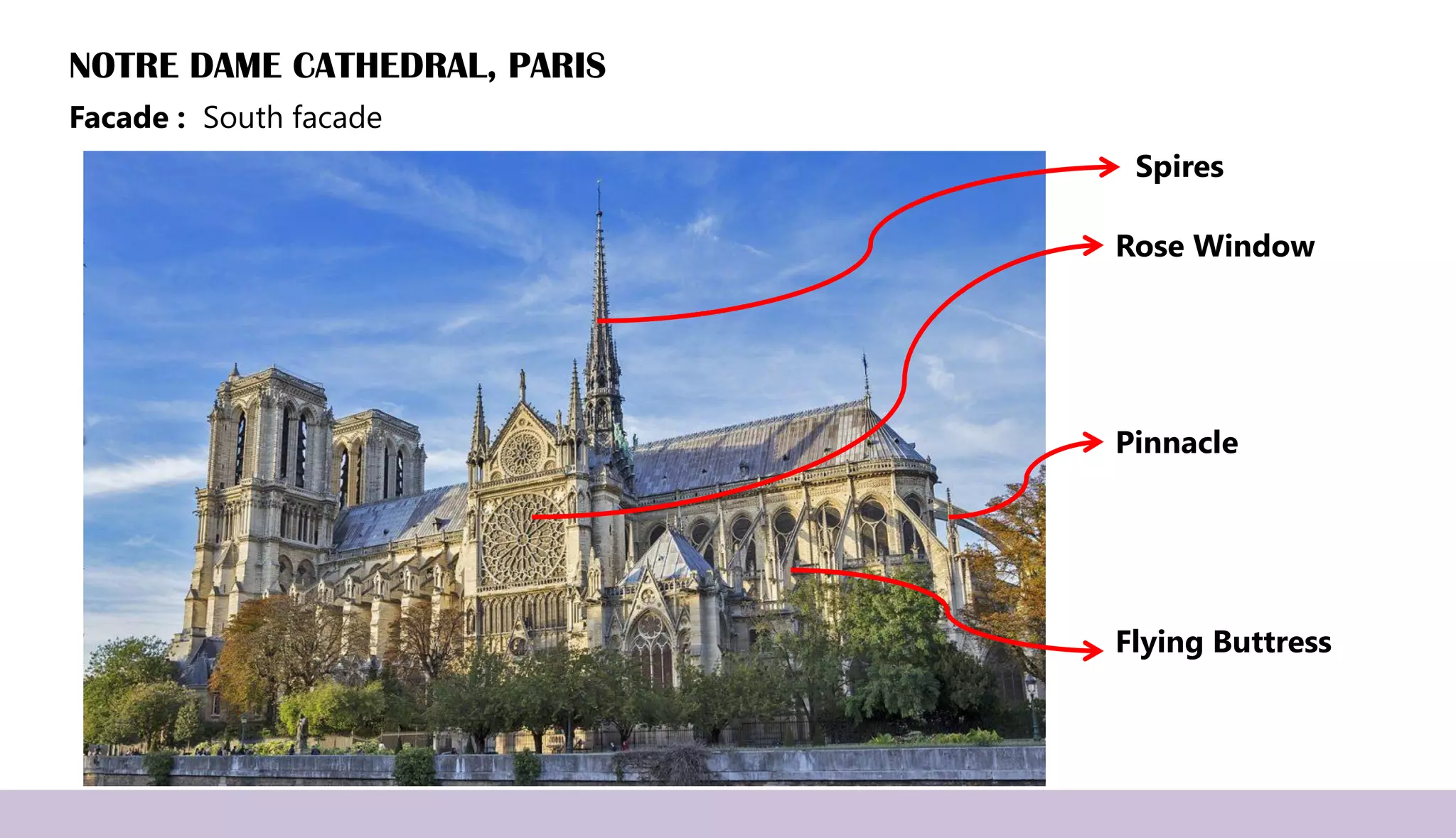
Part A: Multiple Choice Question (Choose ONE letter A-D)
These elements are defining characteristics of which architectural style?
Part B: Short Answer Question (Answer in NO MORE THAN 25 WORDS)
Identify at least two of the key structural innovations visible in the images and explain the unified spatial goal they were designed to achieve.
(Word count for Part B: Please ensure your answer is concise)
Question 9: Architectural Orders & Component Identification
The diagram below shows the entablature of a classical Greek temple, a highly ordered system of architectural components. An individual element is highlighted by the dashed box.
:max_bytes(150000):strip_icc()/column-frieze-77817859-crop2-587300de5f9b584db32d7a85.jpg)
Part A: Multiple Choice Question (Choose ONE letter A-D)
What is the correct architectural term for the highlighted component?
Part B: Short Answer Question (Answer in NO MORE THAN 20 WORDS)
Describe the primary role and position of this element relative to the components directly above and below it.
(Word count for Part B: Please ensure your answer is concise)
Teacher's Guide & Rubric (Restricted Access)
Teacher's Guide: IELTS & Architecture Profile Analysis
This section provides detailed analysis for evaluating student responses, connecting their architectural understanding with key IELTS assessment criteria for comprehensive profiling.
Question 8 Analysis & Rubric
Correct Answer: (B) Gothic
The pointed arch and flying buttress channel loads outwards, facilitating taller structures with extensive window space, achieving luminosity and a sense of verticality.
(24 words - fits within the 25-word limit)
Knowledge Points & Logic Dissection:
- Core Knowledge (Architectural History & Visual Literacy): The student must visually recognize the defining features of Gothic architecture. This includes identifying specific elements like the pointed arch, ribbed vault, flying buttress, and rose window, and associating them correctly with the Gothic style.
- Architectural Terminology (IELTS Lexical Resource): The student's ability to use precise and academic architectural terms (e.g., "pointed arch," "flying buttress," "channel loads," "luminosity," "verticality") is crucial. Errors here indicate a need for vocabulary building.
- Structural & Spatial Reasoning (IELTS Coherence & Cohesion, Task Achievement): This is the key diagnostic element. The student must demonstrate an understanding of how these elements function as a *system* to achieve a specific *spatial goal*.
- Problem Identification: Recognize the limitations of earlier styles (e.g., Romanesque's thick walls, dark interiors).
- Innovation Understanding: Grasp how pointed arches reduce lateral thrust and how flying buttresses counter outward forces.
- Synthesis & Unified Goal: Connect these structural innovations to the desired aesthetic and experiential outcome: increased height, larger windows, and a light-filled, transcendent interior. The justification must clearly link the *means* (innovations) to the *end* (spatial goal).
Villain's Playbook: Common Traps & Error Analysis (IELTS Perspective)
- The "Vague Description" Trap (IELTS Task Achievement & Lexical Resource): Student correctly identifies Gothic but provides a non-technical justification like, "The buildings are pointy and have big windows." This indicates visual recognition but a lack of precise architectural vocabulary and conceptual understanding required for academic discourse.
- The "List without a Link" Trap (IELTS Coherence & Cohesion): Student correctly names elements ("It has pointed arches and flying buttresses") but fails to explain *how* they work together or *what unified goal* they achieve. This suggests difficulty in synthesizing information and forming a coherent argument, even in a single sentence.
- The "Style Confusion" Trap (IELTS Accuracy/Knowledge): Student chooses an incorrect style (e.g., Victorian, Classical). This points to fundamental gaps in architectural history knowledge and visual differentiation skills.
- Over-Word Count (IELTS Task Achievement): Justification exceeds the word limit, indicating difficulty in summarizing and expressing ideas concisely, a key skill for various IELTS writing tasks.
Rubric for Student Profile Analysis
| Dimension | Level 3: Sophisticated Reasoning (IELTS Band 7+) | Level 2: Basic Reasoning (IELTS Band 5-6) | Level 1: Flawed or Vague Reasoning (IELTS Band <5) |
|---|---|---|---|
| Visual Analysis & Style ID (IELTS Reading Comprehension) | Correctly identifies the style and explicitly links at least two key structural elements (e.g., pointed arch, flying buttress) to the resulting spatial quality (height, light), all within the word limit. | Correctly identifies the style and names one or more features, but does not clearly explain how they function together as a system or what their unified purpose is, or slightly exceeds word limit. | Chooses the incorrect style, provides a purely descriptive or technically inaccurate justification, or significantly exceeds the word limit with irrelevant details. |
| Lexical Resource (IELTS Writing) | Uses a range of precise architectural terms (e.g., "pointed arch," "flying buttress," "channel loads," "luminosity," "verticality") appropriately and accurately. | Uses some correct architectural terms but may mix with simple, everyday language ("pointy arches," "wall supports," "big windows") or has minor inaccuracies. | Uses incorrect terminology or vocabulary that is vague, repetitive, or unrelated to the style, making the meaning unclear. |
| System Thinking & Coherence (IELTS Coherence & Cohesion, Task Achievement) | Demonstrates a clear understanding of the cause-and-effect relationship between structural innovations and the aesthetic/spatial goal of the Gothic style, presented coherently. | Identifies correct parts but the justification does not fully assemble them into a coherent system; the "how" and "why" are implied rather than explicitly stated. | Fails to connect the visual evidence to any underlying structural or philosophical principle, showing a lack of systematic understanding. |
Question 9 Analysis & Rubric
Correct Answer: (C) Frieze
The frieze is the central, often decorated, band of the entablature, situated between the architrave (below) and the cornice (above).
(20 words - fits within the 20-word limit)
Knowledge Points & Logic Dissection:
- Core Knowledge (Architectural Terminology & Visual Identification): This question tests the student's knowledge of classical architectural orders. They must visually identify the highlighted component and correctly name it "Frieze." Differentiating it from "Pediment" (a larger triangular gable) is key.
- Architectural Terminology (IELTS Lexical Resource): Accurate use of terms like "Frieze," "Architrave," "Cornice," and "Entablature" is essential.
- Hierarchical Reasoning & Positional Description (IELTS Coherence & Cohesion, Task Achievement): The student must demonstrate understanding of the classical system and the precise order and relationship of its components.
- System Context: Understand that the "entablature" is the horizontal structure supported by columns.
- Component Order: Know the fixed sequence from bottom to top: Architrave → Frieze → Cornice.
- Role & Relationship: Describe the frieze not in isolation but in terms of its position relative to the components above and below, and its primary decorative function within the overall order.
Villain's Playbook: Common Traps & Error Analysis (IELTS Perspective)
- The "Mix-and-Match" Trap (IELTS Lexical Resource Accuracy): Student knows the terms (architrave, frieze, cornice) but cannot recall their correct hierarchical order. Choosing (A) or (B) indicates a memory-based knowledge that is not firmly structured, potentially leading to errors in IELTS cloze tests or summaries.
- The "Location, No Function" Trap (IELTS Task Achievement): Student correctly identifies the frieze and its general location ("It's the part in the middle") but fails to describe its primary role (often decorative/sculptural). This suggests an incomplete understanding of architectural elements beyond their physical placement.
- The "Wrong System" Trap (IELTS Accuracy/Knowledge): Student chooses (D) Pediment, confusing a component of the entablature with a larger structural element. This indicates a broader lack of understanding of classical temple composition.
- Over-Word Count (IELTS Task Achievement): Similar to Q8, exceeding the word limit shows a struggle with conciseness and effective summarization.
Rubric for Student Profile Analysis
| Dimension | Level 3: Sophisticated Reasoning (IELTS Band 7+) | Level 2: Basic Reasoning (IELTS Band 5-6) | Level 1: Flawed or Vague Reasoning (IELTS Band <5) |
|---|---|---|---|
| Terminology & Position (IELTS Reading Comprehension) | Correctly identifies the frieze and accurately describes its position (between architrave and cornice) and primary role (decorative/sculptural) within the word limit. | Correctly identifies the frieze but describes its position vaguely ("it's in the top section") or omits its role, or slightly exceeds word limit. | Chooses the incorrect term; justification is either incorrect, too vague, or significantly exceeds the word limit. |
| Lexical Resource (IELTS Writing) | Uses a full set of precise terms: "frieze," "architrave," "cornice," "entablature," "decorative/sculptural" appropriately. | Uses the correct term "frieze" but describes its context with simpler language ("the beam below," "the roof part above") or has minor lexical inaccuracies. | Uses vague or incorrect language ("the picture part," "the middle block"), hindering clear communication. |
| System Knowledge & Accuracy (IELTS Coherence & Cohesion, Task Achievement) | Justification demonstrates a clear understanding of the hierarchical order of the entablature and the specific role of the frieze within that classical system. | Shows recognition of the individual part but the justification does not clearly articulate its relationship to the whole system, or its description of role/position is partially accurate. | Fails to demonstrate any understanding of the classical orders as a structured system of components, leading to misidentification or illogical description. |