Architecture Assessment
IELTS & University Preparation Module
Examination Paper
SECTION 1: Architecture & Material Innovation
The Evolution of Architectural Expression and Materials
Architecture, at its core, is a dialogue between human needs, aesthetic ambition, and the capabilities of available materials. Throughout history, the evolution of construction materials has directly influenced architectural styles and structural possibilities. For centuries, builders relied on natural materials like stone, timber, and traditional binders such as **lime** mortar. These materials, while robust and enduring, imposed certain limitations on form and scale, leading to architectural expressions defined by mass and load-bearing structures.
The 19th and 20th centuries heralded a revolution with the advent of engineered materials. Among the most transformative was **Reinforced Cement Concrete (RCC)**. This composite material typically consists of cement (acting as the binder), aggregates (like sand and gravel providing bulk and stability), and steel reinforcement (imparting tensile strength, which concrete lacks). RCC allowed architects to transcend traditional constraints, enabling the creation of vast, open spaces and daring cantilevered forms previously unimaginable. Its versatility, durability, and cost-effectiveness quickly established RCC as a cornerstone of modern construction globally.
This material innovation coincided with, and indeed facilitated, the emergence of radical new architectural philosophies. One such movement, gaining prominence in the late 20th century, was **Deconstructivism**. Characterised by fragmentation, non-linearity, and a challenging of traditional notions of harmony and symmetry, Deconstructivist architects sought to create buildings that appeared to defy gravity and conventional structure. They often employed complex geometries, dynamic forms, and innovative material applications to achieve these effects. A prime example is the **Guggenheim Museum Bilbao**, designed by the renowned American-Canadian architect **Frank Gehry**. Completed in 1997, the museum is celebrated for its undulating, titanium-clad surfaces that reflect the surrounding city and river, creating a fluid, almost organic aesthetic. This iconic structure not only revitalised Bilbao but also cemented Deconstructivism's place as a significant chapter in contemporary architectural history, demonstrating how material mastery can unlock unprecedented artistic freedom.
Questions 1-3: True/False/Not Given
TRUE if the statement agrees with the information
FALSE if the statement contradicts the information
NOT GIVEN if there is no information on this
1. Before the 19th century, architects primarily used materials that limited the creation of complex shapes.
2. Steel is incorporated into Reinforced Cement Concrete primarily to increase its compressive strength.
3. Frank Gehry has designed several buildings in the Deconstructivist style across multiple continents.
Question 4: Multiple Choice
4. Which of the following is NOT considered a primary component of modern RCC, according to the passage?
Questions 5-6: Identify the Building and its Architect
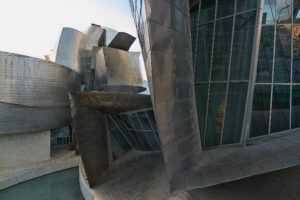
5. The building pictured above, known for its unique form and material, is a landmark of Deconstructivist architecture. Identify the building and its architect from the options below, as discussed in the passage.
6. According to the passage, what specific material gives the exterior of the Guggenheim Museum Bilbao its distinctive reflective quality? (No more than THREE words)
Instructor's Guide & Rubric
1: TRUE
2: FALSE
3: NOT GIVEN
Question 4: D) Lime
Question 5: B) Guggenheim Museum Bilbao, by Frank Gehry
Question 6: titanium (or titanium cladding)
General IELTS Reading Skills & Architectural Context
This section of the test is designed to mimic an IELTS Academic Reading module, focusing on content relevant to aspiring architecture students. It assesses several key IELTS reading skills, including:
- Skimming and Scanning: Quickly identifying the general idea and locating specific information.
- Detailed Comprehension: Understanding explicit information and specific arguments.
- Inference: Drawing conclusions from information that is not explicitly stated.
- Vocabulary in Context: Understanding architectural and construction terminology.
- Identifying Main Ideas and Supporting Details: Grasping the core message of paragraphs and recognizing evidence.
For architecture students, these skills are critical not only for IELTS but also for academic success, where they will frequently encounter complex theoretical texts, material specifications, and historical analyses.
Questions 1-3: True/False/Not Given Analysis & Rubric
1. Knowledge Points & Skills Tested:
- IELTS Reading Skill: True/False/Not Given comprehension. This requires precise understanding of the passage and careful comparison with the statement, particularly distinguishing between "False" (explicit contradiction) and "Not Given" (no information to confirm or deny).
- Architectural Context: Understanding historical material limitations, specific properties of RCC components, and the scope of an architect's work as presented in the text.
- Vocabulary: "tensile strength," "compressive strength," "limitations," "revitalised," "cemented."
2. Model Answer & Solution Logic:
Correct Answers:
1: TRUE
2: FALSE
3: NOT GIVEN
Step-by-Step Logic:
- Question 1: "Before the 19th century, architects primarily used materials that limited the creation of complex shapes."
- Locate: Paragraph 1: "For centuries, builders relied on natural materials like stone, timber, and traditional binders such as lime mortar. These materials, while robust and enduring, imposed certain limitations on form and scale..."
- Compare: The statement aligns directly with "imposed certain limitations on form and scale." "Complex shapes" can be inferred from "form and scale."
- Conclusion: TRUE.
- Question 2: "Steel is incorporated into Reinforced Cement Concrete primarily to increase its compressive strength."
- Locate: Paragraph 2: "This composite material typically consists of... steel reinforcement (imparting tensile strength, which concrete lacks)."
- Compare: The passage explicitly states steel provides "tensile strength," not compressive strength. Compressive strength is generally a property of concrete itself.
- Conclusion: FALSE.
- Question 3: "Frank Gehry has designed several buildings in the Deconstructivist style across multiple continents."
- Locate: Paragraph 3 mentions Frank Gehry designed the Guggenheim Museum Bilbao, which is a prime example of Deconstructivism. It states he is American-Canadian and the building is in Bilbao.
- Compare: The passage confirms Gehry designed the building in this style. However, it only mentions one specific building and provides no information about whether he designed "several buildings" or if these were "across multiple continents."
- Conclusion: NOT GIVEN.
3. Common Hurdles & Error Analysis (Villain's Playbook):
The Trap (The "Almost True" or "Assumption" Villain): Students might incorrectly infer "several buildings" from "prime example" or assume an architect of Gehry's stature would have international projects, leading to a "TRUE" answer for Q3. They might also confuse "tensile" with "compressive" strength or lack the precise vocabulary, leading to "TRUE" for Q2 if they just see "strength."
Diagnostic Value:
- Accurate T/F/NG: Demonstrates strong IELTS reading skills, attention to detail, and ability to differentiate subtle textual cues.
- Confusing FALSE/NOT GIVEN: Highlights a common IELTS challenge, indicating the student might be inferring too much or not rigorously checking for explicit contradiction.
- Misinterpreting key terms (e.g., tensile/compressive): Points to a need for more precise architectural vocabulary development.
4. Rubric & Student Profile Mapping:
| Response Level | Student's Answer & Reasoning | Inferred Thought Process / Profile |
|---|---|---|
| Level 4 (Exceeds) | All correct with clear justification for T/F/NG based solely on passage evidence. Identifies distractors. | IELTS Reading Strategist: Masters T/F/NG distinction, precise lexical understanding, and avoids assumptions. Excellent for academic texts. |
| Level 3 (Meets) | Most correct, with one common error (e.g., Q3 as TRUE due to reasonable inference). Shows good general comprehension. | Contextual Comprehender: Understands explicit information well but might struggle with strict "Not Given" identification or subtle vocabulary nuances under pressure. |
| Level 2 (Approaching) | Significant errors, particularly confusing TRUE/FALSE/NOT GIVEN, or misinterpreting key architectural terms (e.g., Q2 as TRUE). | Surface Reader: Struggles with detailed reading and precise comparison, possibly guessing or making broad assumptions. Needs focused practice on specific IELTS question types. |
| Level 1 (Needs Dev.) | Multiple incorrect answers, indicating a lack of basic comprehension of the passage or the T/F/NG task. | Foundational Skills Gap: Requires extensive development in reading strategies, vocabulary, and understanding question types. |
Question 4: Multiple Choice Analysis & Rubric (Original Q7, now Q4)
1. Knowledge Points & Skills Tested:
- Architectural Knowledge: Understanding the fundamental composition of Reinforced Cement Concrete (RCC). Differentiating between modern and historical binding agents based on the passage.
- Categorical Reasoning: Classifying materials based on their role within a composite system (binder, aggregate, reinforcement) *as described in the passage*.
- IELTS-Related Skill: Locating specific details within a text (scanning) and demonstrating understanding of vocabulary in context.
2. Model Answer & Solution Logic:
Correct Answer: D) Lime
Step-by-Step Logic (Applying Reading Comprehension & "Name the Club" Protocol):
- Scan the Passage: Locate the section discussing RCC components in Paragraph 2.
- Identify RCC Components: The passage explicitly states: "This composite material typically consists of **cement** (acting as the binder), **aggregates** (like sand and gravel providing bulk and stability), and **steel reinforcement** (imparting tensile strength...)."
- Identify the Anomaly: Compare the given options (A, B, C, D) with the listed components. Cement, Aggregate, and Steel are explicitly mentioned.
- Evaluate 'Lime': Paragraph 1 mentions "traditional binders such as **lime** mortar." The passage clearly distinguishes lime as a *traditional* material, contrasted with modern RCC components.
- Conclusion: Lime is NOT considered a primary component of *modern* RCC based on the passage.
3. Common Hurdles & Error Analysis (Villain's Playbook):
The Trap (The "Lexical Confusion" Villain): Students might see both "cement" and "lime" mentioned as "binders" in the general context of construction and incorrectly assume both are part of modern RCC, failing to notice the distinction made in the passage (traditional vs. modern components). They might also choose steel if they're focused on "not a mineral" rather than "not a primary component of RCC" as per the text.
Diagnostic Value:
- Choosing 'D' (Correct): Shows excellent ability to scan for specific information, understand distinctions made in the text, and apply architectural vocabulary correctly in context.
- Choosing 'C' (Steel): Indicates a superficial classification (metal vs. mineral) rather than understanding the *functional role* within the RCC composite *as described in the passage*.
- Choosing 'A' or 'B': Signals a significant failure to locate or comprehend the core information about RCC in the passage.
4. Rubric & Student Profile Mapping:
| Response Level | Student's Answer & Reasoning | Inferred Thought Process / Profile |
|---|---|---|
| Level 4 (Exceeds) | D) Lime. Student explicitly references the passage's distinction between traditional lime and modern RCC components. | Analytical Reader & Material Scientist: Demonstrates precise reading comprehension and applies knowledge of material science within the given context. |
| Level 3 (Meets) | D) Lime. Student correctly identifies lime as not belonging, possibly from prior knowledge reinforced by the passage. | Accurate Detail Spotter: Can locate and process specific details from the text to answer the question, or has strong foundational knowledge that aids rapid understanding. |
| Level 2 (Approaching) | C) Steel. Reasoning focuses on steel's material type (metal) rather than its role in RCC as explained in the text. | Category Generalist: Applies a logical but overly simplistic classification, missing the nuanced definition provided in the passage. Needs to improve detail-oriented reading. |
| Level 1 (Needs Dev.) | A) Cement or B) Aggregate. Student fails to extract basic information about RCC components from the passage. | Basic Comprehension Gap: Struggles with finding and understanding explicit information in a text. |
Questions 5-6: Building & Architect Identification Analysis & Rubric (Original Q8, now Q5-6)
1. Knowledge Points & Skills Tested:
- Architectural Knowledge: Identification of major international architectural landmarks, linking visual information with textual description. Association of iconic buildings with their architects and styles (Deconstructivism).
- Visual Literacy: The ability to recognize a specific building from a photograph and connect it to textual details.
- IELTS-Related Skill: Matching visual information to textual descriptions, identifying specific details (gap-fill), and understanding descriptive language related to architecture.
- Vocabulary: "undulating," "titanium-clad," "sculptural forms," "Deconstructivism."
2. Model Answer & Solution Logic:
Correct Answer Q5: B) Guggenheim Museum Bilbao, by Frank Gehry
Correct Answer Q6: titanium (or titanium cladding)
Step-by-Step Logic (Applying "Match the Icon" & Detail Extraction Protocols):
- Visual Analysis (Q5): Observe the image's key features: non-geometric, sculptural forms, metallic (titanium-like) cladding, and a riverside location.
- Scan Passage for Keywords (Q5): Look for "Guggenheim," "Bilbao," "Gehry," "Deconstructivism," "titanium," "sculptural forms."
- Connect Visual and Text (Q5): Paragraph 3 explicitly states: "A prime example is the **Guggenheim Museum Bilbao**, designed by the renowned American-Canadian architect **Frank Gehry**. Completed in 1997, the museum is celebrated for its undulating, **titanium-clad** surfaces... This iconic structure... cemented **Deconstructivism's** place..." The image perfectly matches this description.
- Evaluate Options (Q5): The text and image clearly point to option B, distinguishing it from other famous but visually distinct buildings.
- Locate Specific Detail (Q6): For Question 6, return to the part of Paragraph 3 describing the Guggenheim Museum Bilbao. The text states it is "celebrated for its undulating, **titanium-clad** surfaces."
- Extract & Formulate Answer (Q6): The specific material is "titanium." "Titanium cladding" also fits the "no more than THREE words" instruction.
3. Common Hurdles & Error Analysis (Villain's Playbook):
The Trap (The "General Knowledge vs. Passage Specifics" Villain): For Q5, students might know the building but miss the architect, or confuse it with other similarly "modern" or "sculptural" buildings (like Sydney Opera House). For Q6, they might struggle with precise vocabulary or fail to scan for the exact material mentioned, potentially guessing "metal" or "steel" if not careful.
Diagnostic Value:
- Choosing 'B' for Q5 & 'titanium' for Q6 (Correct): Indicates strong integration of visual and textual information, precise detail extraction, and robust architectural knowledge.
- Choosing 'A' for Q5: Shows general recognition of "iconic sculptural building on water" but poor attention to specific visual cues or details in the passage (e.g., titanium vs. shells, Gehry vs. Utzon).
- Incorrect/Vague answer for Q6: Highlights a weakness in extracting exact details from the text or a lack of precise vocabulary.
4. Rubric & Student Profile Mapping:
| Response Level | Student's Answer & Reasoning | Inferred Thought Process / Profile |
|---|---|---|
| Level 4 (Exceeds) | Q5 & Q6 correct. Student can explain how the image and passage details collaboratively lead to the answer. | Integrated Information Processor: Expertly synthesizes visual and textual data, demonstrates strong architectural literacy and IELTS detail extraction. |
| Level 3 (Meets) | Q5 correct, Q6 correct. Relies heavily on direct matching from the passage and visual cues. | Accurate Recognizer: Good at matching explicit information from the text to the question, and identifying visual landmarks. |
| Level 2 (Approaching) | Q5 incorrect (e.g., Sydney Opera House) or Q6 provides a vague answer (e.g., 'metal'). Confusion between similar concepts. | Partial Integrator: Recognizes general categories but struggles with precise identification and differentiation based on specific textual or visual details. |
| Level 1 (Needs Dev.) | Both Q5 and Q6 are incorrect, showing a fundamental lack of visual-factual knowledge or inability to extract relevant details from the passage. | Limited Factual & Reading Base: Requires significant development in architectural history, visual literacy, and targeted IELTS reading skills for detail extraction. |